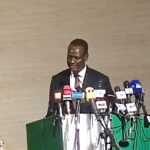


The Federal Government has unveiled 10 measures aimed at cushioning the impact of high petrol prices on households and businesses, insisting that the interventions do not amount to a return to fuel subsidy.
Minister of Finance and Coordinating Minister of the Economy, Taiwo Oyedele, disclosed this on Thursday at a press conference on fuel prices and the subsidy question.
Oyedele said the measures were necessary because the removal of fuel subsidy had imposed significant pressure on households, adding that the government was determined to provide targeted relief without reversing the reforms.
He said the first measure was a 30-day margin discount on petrol sold at NNPC retail stations, with priority given to public transporters.
According to him, the government will also introduce forward sales of crude oil to local refineries as domestic crude production increases and previously committed volumes are freed.
He explained that selling crude to refiners ahead of time would provide certainty to operators and help shield domestic petrol prices from volatility in the international oil market.
Oyedele said the government was also negotiating a ceiling of about N1,350 per litre on the ex-gantry or landing cost of petrol, which would be reviewed monthly.
He stressed that the arrangement was not a subsidy or price control, but a mechanism designed to smooth out sharp fluctuations in petrol prices.
“The idea is simple. N1,500 a litre today and N1,500 a litre tomorrow is better than N1,500 a litre today and N1,300 a litre tomorrow because volatility itself adds to uncertainty and costs,” he said.
The minister said the government would also work with state governments to eliminate illegal taxes and levies imposed on the movement of goods, which he said contribute significantly to transportation and food costs.
He cited reports of transporters spending as much as N700,000 per truck moving food from northern Nigeria to the South as an example of the burden created by multiple levies and logistics costs.
Other measures announced include increased cash transfers to vulnerable households and subsidised credit for small businesses and consumers, as well as an accelerated rollout of Compressed Natural Gas (CNG).
Oyedele said the government would encourage transport operators benefiting from lower fuel costs to pass the savings to passengers through reduced fares.
He also disclosed that the government would consider an excess profit tax on operators across the energy value chain who take undue advantage of consumers.
According to him, proceeds from such a measure would be directed exclusively towards cushioning the impact of higher energy prices through transport support and vouchers for vulnerable low-income earners.
The government is also moving to reduce regulatory costs that add to the cost of doing business and ultimately increase the prices of goods and services.
Oyedele listed the establishment of a National Strategic Oil Reserve as another measure, saying refined petroleum products could be released into the market under clearly published rules whenever disruptions, hoarding or supply manipulation threaten price stability.
He added that improved traffic and logistics management would be pursued to reduce fuel consumption, particularly in major urban centres, while measures would also be taken to make the movement of goods more efficient and cheaper.
The minister reiterated that the government would not return to blanket fuel subsidy, warning that doing so could recreate the economic problems that led to its removal.
“To do so would amount to creating long-term harm for a short-term cure,” Oyedele said.
He said the government’s objective was instead to ensure that the gains of the ongoing reforms reached Nigerians more quickly and in more tangible ways.
Oyedele added that the Federal Government was also working on a comprehensive package of fiscal measures aimed at bringing inflation down to single digits sustainably.
He said the government recognised the hardship being experienced by Nigerians but maintained that reversing the reforms would expose the country to renewed fiscal pressure, foreign exchange instability, fuel scarcity and smuggling.
“We cannot afford to live through it again,” the minister said.