





Politics
Alia Urges Ado/Okpokwu/Ogbadibo Residents to Exploit Agricultural, Mineral Wealth
By Terdue Atondu, Makurdi
Benue State Governor, Rev. Fr. Dr. Hyacinth Iormem Alia, has called on residents of Ado/Okpokwu/Ogbadibo Federal Constituency to maximise the agricultural and mineral resources in their communities to boost economic growth and improve livelihoods.
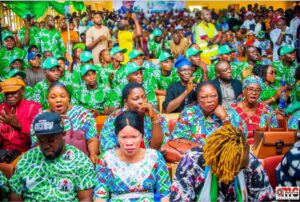
Governor Alia made the call during a town hall meeting with stakeholders and residents of the constituency as part of his ongoing statewide engagement with the people.
He said Benue could no longer afford to be identified mainly as a civil service state, stressing that his administration was pursuing policies aimed at transforming the state into an economic, commercial and industrial hub.
The governor particularly urged farmers to increase production of crops such as cassava and soybean, assuring them that the state’s growing industrial sector would create ready markets for locally produced agricultural commodities.
According to Alia, Benue remains Nigeria’s leading soybean-producing state and one of the world’s major producers of yam, while also ranking among the country’s leading cassava-producing states.
He said the state government had continued to subsidise agricultural inputs as part of efforts to encourage farmers and increase food production.
Alia disclosed that fertiliser purchased by the state government, which ordinarily sells for between N67,000 and N70,000 per bag, was being sold to farmers at about N25,000, with transportation bringing the effective cost to approximately N28,000 per bag.
He also encouraged farmers to embrace dry-season farming, assuring them of government support to enable them produce throughout the year.
The governor explained that the administration’s industrialisation agenda was designed to complement agriculture by creating markets for raw materials produced by farmers while generating employment opportunities for residents.
On the state’s mineral resources, Alia urged traditional rulers and community leaders to protect the deposits in their domains and ensure that investors and mining operators complied with established procedures.
He warned traditional rulers against entering into individual agreements with prospective miners without involving the appropriate government authorities.
According to him, the state government had separated solid minerals from the former combined land and survey structure, while moves were underway to establish a full-fledged Ministry of Natural Resources.
Alia described Benue’s mineral deposits as enormous, citing coal and limestone among resources capable of contributing significantly to the state’s economic development if properly harnessed.
He added that his administration was working to revive and strengthen industrial activities across the state, noting that several factories established within the last three years were already operational.
Speaking on education, the governor disclosed that his administration had recruited 9,700 teachers for primary schools and was preparing to commence another, larger recruitment exercise that would cover secondary schools.
He advised qualified teachers from Ado, Okpokwu and Ogbadibo to prepare for the exercise, adding that those requiring additional training would be given opportunities to upgrade their skills before deployment.
The governor also called for collective efforts to sustain peace and security across the state, stressing that security was a shared responsibility.
He commended residents of communities previously affected by insecurity for returning to their farms, but noted that internally displaced persons were still scattered across various parts of the state.
Alia said his administration remained committed to creating the conditions necessary for farmers to return fully to their farms and increase food production, thereby helping to reduce food inflation.
He further urged residents of the constituency, traditional institutions and the church to collaborate with government in shaping the future of Benue.
The governor disclosed that the state was developing a 30-year development plan to provide a long-term framework for sustainable growth and development.
He said the ultimate objective was to move Benue beyond its traditional dependence on the civil service by fully harnessing its agricultural, industrial and mineral resources to create sustainable prosperity for its people.