
News
Engineering Leaders Chart New Path for Consultancy and Infrastructure Through Reform
Featured by Matthew Otabe
Engineering leaders have called for a fundamental transformation of engineering consultancy practice in Nigeria and across Africa, stressing the need for innovation, stronger professional capacity, ethical leadership and institutional reforms to achieve sustainable infrastructure development.
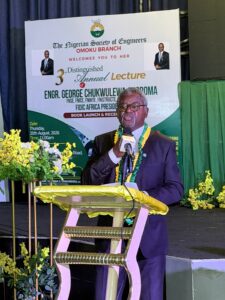
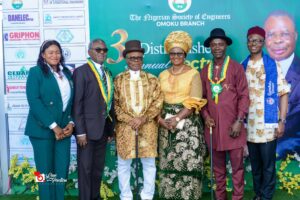
The call was made at the 3rd Engr. George Chukwulewa Okoroma Distinguished Annual Lecture, organised by the Nigerian Society of Engineers (NSE), Omoku Branch, in Port Harcourt, Rivers State.

The lecture, held at Astro Hall on August 20, 2026, centred on the theme, “Reshaping Engineering Consultancy Practice for Sustainable Infrastructure Development: Challenges, Innovations and Future Directions.”
The theme captured an increasingly urgent concern within the engineering profession: how to ensure that consultancy practice keeps pace with rapid technological changes, economic pressures, environmental challenges and the growing infrastructure needs of developing societies.
Delivering the lecture, Engr. Dr Edward Nwachukwu Moore, FNSE, FNICE, FNIHTE, drew attention to the critical role of engineering consultants in shaping the quality, durability and sustainability of infrastructure projects.
The discussions at the event underscored that sustainable infrastructure cannot be achieved through construction alone. It requires competent professionals who can provide innovative solutions, apply emerging technologies, maintain global standards and understand the social and environmental implications of engineering decisions.
Beyond conventional engineering practice
For many years, engineering consultancy in Nigeria has operated within an environment characterised by infrastructure deficits, limited financing, regulatory challenges and, in some cases, inadequate professional capacity.
But the changing nature of infrastructure development is creating new demands on consultants.
From smart cities and renewable energy to climate-resilient infrastructure, digital engineering and advanced project-management systems, professionals are increasingly required to combine traditional engineering expertise with technological innovation and multidisciplinary collaboration.
The Port Harcourt lecture therefore provided an opportunity for professionals to reflect on whether existing consultancy models are sufficiently equipped to respond to these emerging realities.
Participants emphasised the importance of continuous professional development, mentorship and knowledge transfer, particularly as the country seeks to build a new generation of engineers capable of competing globally.
The message was clear: Nigeria’s infrastructure challenges require not only more projects, but better engineering thinking.
Honouring a career built around engineering and service
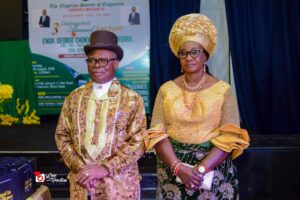
The lecture series was established by the NSE Omoku Branch in honour of Engr. George Chukwulewa Okoroma, FNSE, FNICE, FNIHTE, FNIStructE, FAEng, JP, whose career has spanned more than four decades.
Okoroma, a civil engineer trained in France, began his professional career in construction and project management before establishing engineering enterprises, including Gambeta Nigeria Limited and GAPEC Consultants Limited.
His career has extended beyond private consultancy into professional leadership, infrastructure development and human-capacity building.
He served as a pioneer chairman of the NSE Omoku Branch and later became President of the Association for Consulting Engineering in Nigeria (ACEN).
His contribution to professional engineering leadership also took him to the continental stage through the International Federation of Consulting Engineers (FIDIC) Africa.
After serving as Honorary Treasurer, Executive Committee Member and later Vice President of FIDIC Africa, Okoroma assumed the presidency of the organisation in May 2026.
His inauguration as President of FIDIC Africa at the organisation’s Infrastructure Conference in Accra, Ghana, marked another significant chapter in a career closely associated with consulting engineering and infrastructure development.
His continental role places him at the centre of conversations on how Africa can improve infrastructure delivery, strengthen consulting capacity and develop sustainable engineering solutions.
A lecture with a larger purpose
Beyond celebrating Okoroma, the annual lecture was conceived as a platform for professional dialogue.
The NSE Omoku Branch used the occasion to bring engineers and other stakeholders together to examine the challenges confronting the profession and explore practical approaches to improving engineering outcomes.
That approach is particularly relevant at a time when Nigeria faces a substantial infrastructure gap.
Roads, bridges, housing, water systems, power infrastructure and other public assets require not only significant investment but also competent planning, design, supervision and maintenance.
Poor consultancy practice can translate into cost overruns, delays, defective projects and infrastructure that fails to deliver value over its intended lifespan.
Conversely, strong professional consultancy can help governments and private investors make better decisions, manage risks and maximise the value of infrastructure investments.
The lecture consequently reinforced the argument that the future of infrastructure development is inseparable from the future of engineering consultancy.
Professionalism, integrity and mentorship
Another recurring issue at the event was the importance of professional ethics.
Speakers and participants highlighted competence, integrity, innovation, mentorship and commitment to service as essential ingredients for a stronger engineering profession.
For a profession whose decisions can determine the safety and functionality of major infrastructure, technical competence must be accompanied by professional responsibility.
The emphasis on mentorship was equally significant.
With experienced engineers such as Okoroma having spent decades in practice and professional leadership, the transfer of institutional knowledge to younger professionals remains critical.
The challenge for the next generation, therefore, is not simply to inherit existing practices but to improve them.
Preserving a professional legacy
The event also featured the launch of Edged in Excellence: Becoming a Leading Professional, a biography documenting Okoroma’s personal, professional and spiritual journey.
Reviewed by Dr Emmanuel David Dorgbaa, FMCDI, FAIPC, Founder and Executive Director of the African Institute of Public Speaking and Communication Excellence (AIPSCE), the book was described as combining biography, personal testimonies, Christian teachings and professional history.
Its significance, however, extends beyond the celebration of one individual.
The publication seeks to preserve lessons from a career spanning engineering, entrepreneurship, leadership, faith and service—experiences that can serve as reference points for younger professionals navigating their own careers.

The road ahead
The central message from the Port Harcourt gathering was that Africa’s infrastructure future will depend heavily on the capacity of its engineering professionals to adapt.
Technology will continue to change how projects are designed, delivered and monitored. Climate pressures will demand more resilient infrastructure. Financial constraints will require greater efficiency and value for money. At the same time, increasingly complex projects will require engineers to work across disciplines and borders.
For Nigeria, these realities make reform of consultancy practice more than a professional aspiration. It is an important component of national development.
The 3rd George Okoroma Distinguished Annual Lecture consequently served as both a celebration of an accomplished engineer and a reminder that professional excellence must remain a continuing pursuit.
Its broader challenge to the engineering community was unmistakable: to innovate, uphold integrity, strengthen capacity and rethink consultancy practice in order to build infrastructure capable of serving present and future generations.