News
We’re Funding Failure in Advance’: Engineer Bola Urges Sierra Leone to Halt Projects Without Climate Checks
Every road, bridge, or building approved in Sierra Leone without a certified climate risk assessment is “funding failure in advance,” a Nigerian engineering expert warned last week.
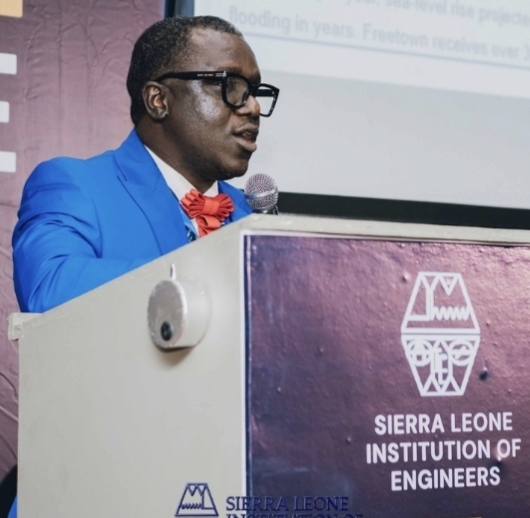
Speaking at the Sierra Leone Institution of Engineers Biennial Conference 2026, Engr. Dr. Bola J. Mudasiru called on Freetown to suspend major infrastructure approvals until they pass strict climate vulnerability checks.
“Every year of inaction compounds the costs — in lives, livelihoods, and in the long-term development trajectory of this nation,” said Mudasiru, Deputy National Chairman of the Nigerian Institution of Highway and Transportation Engineers. “We are not saving money by skipping assessments. We are signing up for repeated reconstruction.”
The Cost of Skipping the Science

In his paper, _“From Vulnerability to Resilience: Building Sustainable and Resilient Infrastructure for Sierra Leone’s Future,”_ Mudasiru laid out the numbers behind the risk.
Sierra Leone already loses an estimated $31.65 million annually to floods and landslides, based on the 2024 ND-GAIN Index. The country ranks 155th out of 182 in climate readiness, scoring 0.297, with a vulnerability index of 0.597.
The geography is unforgiving. The coastline is eroding at 4–6 metres each year. Sea levels are projected to rise 0.63–1.32 metres by 2100. Freetown receives over 3,500mm of rainfall annually, even as rapid urbanisation pushes more people into harm’s way.
And the human toll is recent. In August 2017, the Mount Sugar Loaf landslide killed over 1,000 people and displaced thousands. Post-disaster studies, Mudasiru said, showed that structural and planning failures amplified the destruction.
That tragedy was “not just a natural disaster, but a design and planning failure,” he told delegates.
From Reactive to Preventive
To break what he called a “reactive trap” in infrastructure development, Mudasiru proposed a hard shift to preventive resilience.
First: Make climate vulnerability assessments mandatory before any public infrastructure project is approved. No assessment, no go-ahead.
Second: Build a high-resolution national climate and topographic database to guide engineering design. Engineers can’t design for risks they can’t see.
Third: Ban construction in high-risk floodplains, coastal zones, and landslide-prone areas.
He also urged the government to ring-fence at least 5% of annual infrastructure budgets for maintenance, and to bake climate risk assessments into projects from the first design sketches, not as an afterthought.
“Sierra Leone sits at the confluence of multiple climate threats,” Mudasiru said. “Without climate-informed design, we’re not building for the future. We’re building for the next disaster.”
The Choice Ahead
For Mudasiru, the country’s development path now hinges on a single question: Will Sierra Leone keep rebuilding after disasters, or start designing to survive them?
The data, the disasters, and the dollar losses all point the same way. The conference room heard the warning. The next step is whether policy will follow.