

Featured By Matthew Otabe
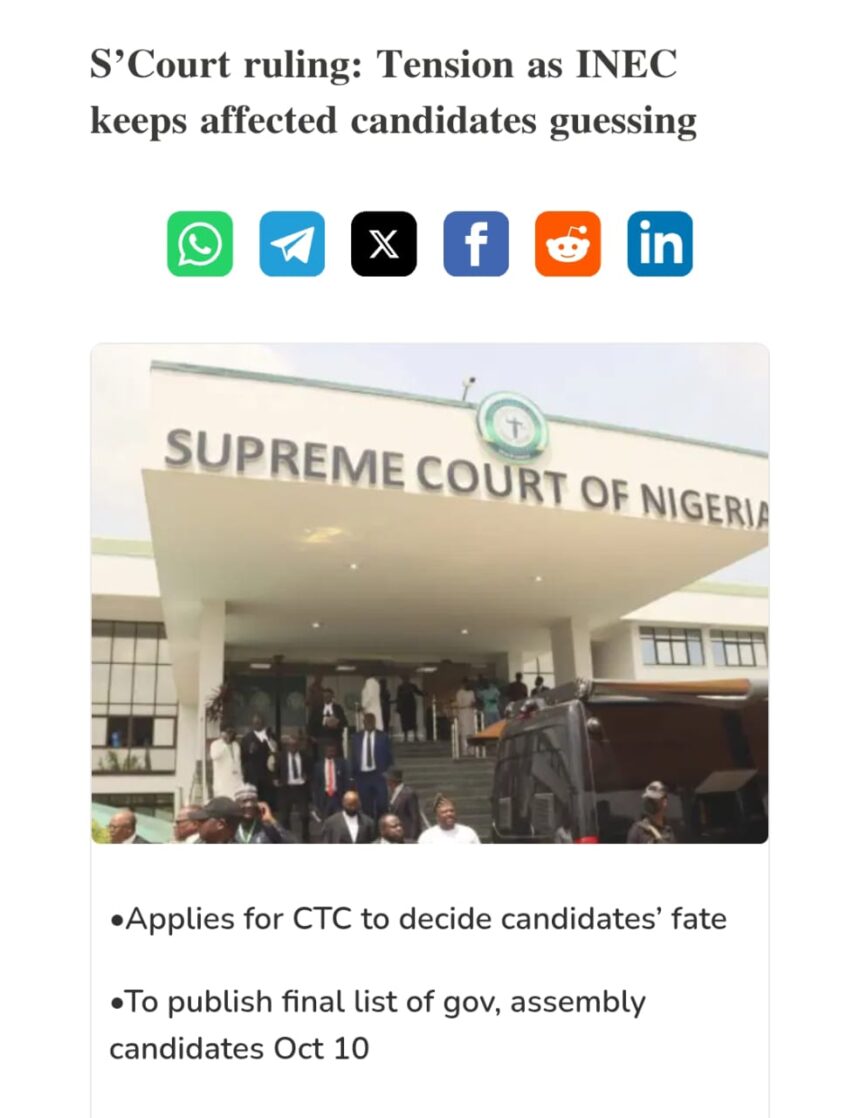
An uneasy wait has enveloped political parties and candidates whose nominations could be affected by the recent Supreme Court judgment on provisions of the Electoral Act 2026, with the Independent National Electoral Commission (INEC) yet to disclose how it will apply the ruling ahead of the publication of the final list of governorship and State House of Assembly candidates.
The uncertainty comes as the commission prepares to meet political parties and other stakeholders on Tuesday, October 6, barely four days before its scheduled publication of the final list.
The Supreme Court, on September 24, 2026, overturned the July 16 judgment of the Court of Appeal and restored key provisions of the Electoral Act 2026 relating to political party membership registers and candidate nomination.
At the centre of the controversy are Sections 77(5), 77(6), 77(7) and 84(2), which deal with membership registers and the process through which political parties nominate candidates.
Rather than immediately pronounce on the implications of the judgment, INEC said it was awaiting the certified true copy (CTC) of the Supreme Court’s decision before determining its next step.
The commission’s National Commissioner and Chairman of its Information and Voter Education Committee, Mohammed Kudu Haruna, said the document had not reached INEC as of Sunday but was expected on Monday.
“The commission is yet to receive the certified true copy of the Supreme Court judgement. Hopefully we will do so tomorrow, (Monday). Until we do so and deliberate on it we cannot make any pronouncement on the issue,” he said.
The Director of Voter Education and Publicity, Victoria Eta-Messi, also confirmed that INEC had applied for the CTC, saying the commission would offer an opinion after studying the judgment.
What is at stake?
The Supreme Court’s decision has reopened questions around political party primaries and the eligibility of persons who participated in them at a time when the Court of Appeal’s judgment had voided the disputed provisions.
The apex court held that the relevant provisions of the Electoral Act 2026 were not inconsistent with the 1999 Constitution, effectively restoring the statutory requirements earlier suspended by the Court of Appeal judgment.
One of the key requirements concerns the submission of verified party membership registers to INEC at least 21 days before a primary, congress or convention.
The restored provisions have generated concern among political parties because several primaries and congresses were conducted while the Court of Appeal judgment was in force.
The immediate question now is whether, and to what extent, candidates who emerged from those processes could be affected by the Supreme Court’s decision.
Already, competing interpretations of the judgment have emerged. For instance, a group recently argued that the Supreme Court ruling did not automatically invalidate the nomination of the APC governorship candidate in Rivers State, illustrating the legal uncertainty surrounding the application of the judgment to individual candidates.
INEC caught between court ruling, electoral timetable
The timing of the judgment has added another layer of uncertainty for the electoral commission.
INEC’s published timetable initially set October 6 as the date for publication of the final list of governorship and State House of Assembly candidates.
The commission is therefore expected to clarify its position after obtaining and reviewing the certified judgment, while also taking into account submissions from political parties and other stakeholders.
The scheduled national stakeholders’ engagement and World Press Conference on Tuesday could consequently provide the first major opportunity for INEC to explain how it intends to proceed.For now, however, the commission has declined to make a definitive pronouncement.
That has left affected candidates and political parties waiting for the electoral umpire’s interpretation of the Supreme Court ruling, with the outcome potentially determining whether some names already submitted or published will remain on the final ballot.
The commission’s position is expected to become clearer once it receives the certified judgment and concludes its legal and administrative review.
High-Profile Aspirants affected by the Ruling
Kingsley Chinda: All Progressives Congress (APC) governorship candidate in Rivers State, whose candidacy faces questions regarding party registers and factional primary processes.
Isa Pantami: Peoples Democratic Party (PDP) governorship candidate in Gombe State, noted for potential compliance reviews concerning his nomination timeline and party membership records.
Donald Duke: Peoples Redemption Party (PRP) presidential standard-bearer and former Cross River State governor, facing similar scrutiny over primary compliance.
Ovie Omo-Agege: Senatorial candidate in Delta Central, whose nomination process is being reviewed under the reinstated statutory membership requirements.
Victor Ochei: Delta North legislative aspirant, also flagged for potential alignment issues with the restored Electoral Act provisions.
Otabe is the Publisher of FirmNews