



The Universal Basic Education Commission (UBEC) has tasked the 36 states and the Federal Capital Territory (FCT) to translate the newly developed Early Childhood Care, Development and Education (ECCDE) Minimum Standards and Implementation Guidelines into practical action plans that will improve early childhood education across the country.
Executive Secretary of UBEC, Dr. Aisha Garba, gave the charge on Monday in Abuja while declaring open a three-day capacity-building workshop for state actors on the utilisation of the ECCDE Minimum Standards, Implementation Guidelines and UNICEF-supported Parental and Community Engagement documents.
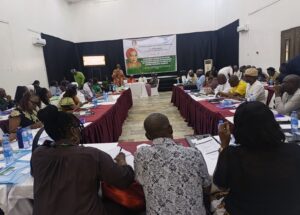
The workshop, held at 3Js Hotel, Jabi, Abuja, brought together Directors of Special Programmes and ECCDE Desk Officers from the 36 states and FCT, representatives of ministries, departments and agencies, development partners, private sector organisations and civil society groups.
Garba said the documents were not meant to be ceremonial but were practical instruments for improving ECCDE delivery at the state, Local Government Education Authority and school levels.
She said, “Over the next three days, we begin the work of moving the new ECCDE Minimum Standards and Implementation Guidelines from paper into practice, for the benefit of the youngest children in every State of the Federation.”
According to her, only 35.6 per cent of Nigerian children aged between 36 and 59 months currently attend any form of early childhood education, leaving about 10 million young children outside ECCDE.

She also cited analysis of the 2021 Multiple Indicator Cluster Survey which, according to her, indicated that about 46 per cent of children aged 24 to 59 months were developmentally off track.
Garba further noted that early stimulation at home remained weakest in areas where the need was greatest, with only about half of children in the Northeast and Northwest receiving such stimulation.
She linked these gaps to later learning difficulties, noting that about 70 per cent of Nigerian 10-year-olds could not read and understand a simple text.
The UBEC boss identified three major changes contained in the new documents, including the separation of ECCDE standards into essential and progressive standards.
She explained that essential standards cover child safety and supervision, including caregiver-child ratios, safeguarding, food and water safety, structural safety and emergency exits, and must be met by every centre, whether public or private.
Progressive standards, she said, would guide centres towards improved quality and help determine areas for intervention funding.
Garba also said the Implementation Guidelines had clarified the ECCDE component of the Matching Grant, operational cost calculations and cost-sharing arrangements between UBEC and state Universal Basic Education Boards.
She added that the ECCDE Action Plan contained in Annex III of the guidelines would serve as the basis for accessing intervention funds.
“Every activity must carry an indicator, a baseline, a target, a responsible officer, a budget line and a due quarter,” she said.
The Executive Secretary charged states to adopt an integrated approach to ECCDE by working with health, nutrition, water and sanitation, women affairs, social welfare and LGEAs.
She said ECCDE could not succeed as a stand-alone education programme because a child suffering from malnutrition, lacking immunisation, protection, registration or access to safe water would struggle to learn regardless of the quality of the classroom.
Garba also directed states to explicitly include ECCDE activities in their State Matching Grant Action Plans and provide appropriate budget lines for classrooms, teaching and learning materials, WASH facilities, caregiver training and mentoring.
“What is not in the Action Plan will not be funded, will not be procured and will not be monitored,” she warned.
She further disclosed that the Senate had in June passed a bill seeking to increase federal intervention under the Universal Basic Education Act from two to five per cent of the Consolidated Revenue Fund, with funds meant for local governments proposed to be channelled directly to Local Education Authorities.
According to her, the bill is awaiting concurrence by the House of Representatives and presidential assent.
Garba urged states to ensure that ECCDE services reach children with disabilities as well as those living in hard-to-reach, nomadic, riverine and conflict-affected communities.
She also stressed the importance of parental and community participation, saying parents, caregivers, School-Based Management Committees, traditional and religious institutions should be regarded as key partners in delivering early childhood education.


UBEC Extends ECCDE Action Plan Deadline
Garba announced that UBEC had extended the deadline for submission of State ECCDE Action Plans from September 30 to October 5, 2026.
She said the extension was granted because the documents were new to many participants, but warned states against using it as an excuse for further delay.
“I expect every State to leave Abuja with a costed, integrated and inclusive draft plan, to present it to your Executive Chairman on your return, and to submit the final plan through the digital planning template within the extended period,” she said.
She warned that plans submitted after October 5 would not be considered for the intervention year.
In his welcome address, Acting Director, Department of Special Programmes and Early Childhood, UBEC, Dr. Chijioke Onwuzurike, said Nigeria currently operates more than 45 early childhood development delivery channels across the health, nutrition, education, agriculture and social protection sectors.
He, however, described the situation as fragmented, noting that many of the platforms do not share data or provide effective referral pathways for children.
Onwuzurike said the workshop was designed to strengthen and operationalise integrated early childhood development pathways so that children would not be lost between different sectors.
He said that over the next 18 months, states were expected to map and streamline their existing ECD platforms, establish functional multi-sectoral coordination mechanisms at state and LGA levels, strengthen frontline workers’ capacity for screening and follow-up, and enforce minimum quality standards.
He urged ECCDE officers to ensure that every child was captured in state planning systems and could transition smoothly from early stimulation and ECCDE into basic education.
Training to Produce State Action Plans
One of the resource persons, Dr. Sunday Jacob, said the workshop was designed to familiarise state officials with the ECCDE Minimum Standards and Implementation Guidelines while equipping them with practical skills to apply the documents in their respective states.
He said participants were expected to develop action plans for implementation, as well as learn how to use monitoring and mentoring tools.
According to him, the training would ultimately benefit children by ensuring that activities in ECCDE centres conform to approved minimum standards, implementation guidelines and the ECCDE curriculum.
Jacob also highlighted the role of parents, explaining that children would be encouraged to undertake learning activities at home with their parents, thereby reinforcing lessons received in school.
He said improved quality in ECCDE centres could also help reduce the number of out-of-school children by making schools more attractive to children and families.
He explained that children who were currently outside formal education could also be encouraged to enrol after seeing other children participate in quality learning activities within their communities.
The resource person said the programme was being implemented by UBEC in collaboration with UNICEF, with two representatives—an ECCDE Desk Officer and a Director of Special Programmes—from each of the 36 states and the FCT participating in the workshop.