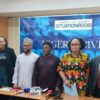
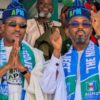
Barely two weeks since the commencement of political campaigns, Opposition parties in Nigeria have intensified efforts to forge a common political front ahead of the 2027 general elections, with six major parties meeting in Abuja on Monday to strategise on how to challenge the ruling All Progressives Congress (APC).
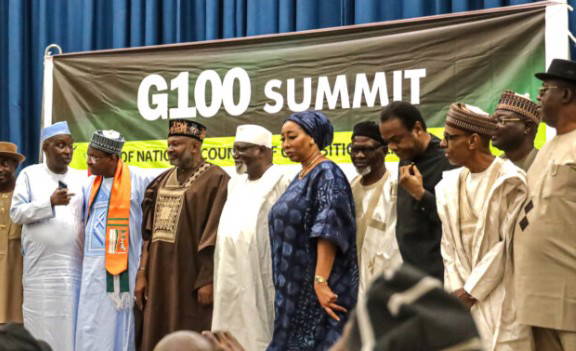
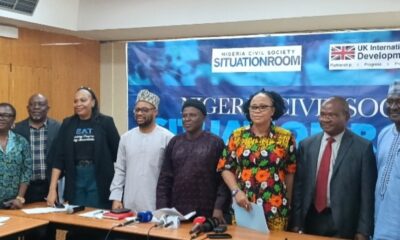
The meeting, held at the Shehu Musa Yar’Adua Centre, brought together party chairmen, presidential candidates, lawmakers and other senior political figures as participants explored the possibility of presenting a united opposition against President Bola Ahmed Tinubu and the APC in 2027.
However, some prominent figures associated with the opposition coalition were absent from the summit, including African Democratic Congress (ADC) presidential candidate, Atiku Abubakar; Labour Party presidential candidate, Peter Obi; and Oyo State Governor, Seyi Makinde.
Among those who attended were Social Democratic Party (SDP) presidential candidate, Adewole Adebayo; Peoples Redemption Party (PRP) presidential candidate, Donald Duke; and Allied Peoples Movement (APM) vice-presidential candidate, Lawal Musa Daura.
The summit was organised with the support of the G100, an initiative promoting cooperation among opposition parties.
A major proposal presented at the meeting was the establishment of a “Government of National Competence” anchored on a single four-year transition administration.
Speaking on the framework, Mallam Salihu Moh. Lukman said the proposed arrangement would have to be backed by a binding agreement among participating parties to prevent it from becoming another political understanding without enforceable commitments.
According to him, the framework proposes “something more demanding than a merger of ambitions” and is designed around competence, integrity, national inclusion and equitable representation.
He said the proposed single four-year term should be contained in an enforceable Transition Charter to ensure that participating parties remain committed to the agreement.
Lukman cited the 2023 presidential election as evidence of the consequences of opposition fragmentation.
He noted that the winning candidate secured just under nine million votes, while two major opposition candidates collectively obtained about 13 million votes.
“Nobody stole thirteen million votes. We divided them ourselves, in public, and we did it knowing exactly what the consequence would be,” he said.
Under the proposed coalition structure, a Central Leadership Committee comprising party chairmen, secretaries, presidential candidates and vice-presidential candidates is expected to coordinate the process.
Publicity and Legal Committees would also be established, while five working groups would develop proposals on democratic renewal, a single-term transition, national reforms, opposition unity and the selection of a consensus presidential candidate.
Lukman, however, clarified that the summit was not intended to compel any political party to dissolve or force candidates to immediately withdraw from the 2027 race.
“It is not asking any party to dissolve. It is not asking any party to disappear into another party. It is not asking any candidate to stand down this morning,” he said.
He warned that reports suggesting that the summit had already agreed on a particular candidate or demanded that candidates step down would be misleading.
The Minority Leader of the House of Representatives, Fred Agbedi, said opposition parties must learn from the coalition that brought the APC to power in 2015.
Agbedi said the House Minority Caucus partnered with the G100 to create a platform capable of bringing opposition parties together, streamlining their ambitions and mounting a collective challenge to the present administration.
“In the spirit of creating a viable opposition and ensuring that we win collectively the 2027 election, the Minority Caucus of the House of Reps decided that we partner with the G100 to see how opposition parties can come together, streamline our ambitions, and ensure that we take this government out,” he said.
PRP presidential candidate, Donald Duke, also pledged to subordinate his personal ambition to the broader opposition project if the parties reached an agreement on a consensus candidate.
“If we think we can go it all alone, then we will fail,” Duke declared.
The call for unity was echoed by ADC National Vice Chairman, South-South, Usani Uguru Usani, who urged opposition parties to stop attacking one another.
“There is something that is happening among the opposition people or party. We seem to be attacking ourselves much more than we attack a common enemy, which is not correct,” he said.
PRP National Chairman, Hakeem Baba-Ahmed, said the opposition was facing significant political pressure but remained committed to the coalition initiative.
“Our back is against the wall, but we’ll fight back. In 2027, we will together remove this government and put the Nigerian nation in a different trajectory,” he said.
At the conclusion of the summit, participating parties adopted a joint communiqué and agreed to commence structured negotiations ahead of another summit.
They also approved the proposed Central Leadership, Publicity and Legal Committees, alongside five working groups mandated to produce their reports within four weeks.
The opposition parties further called for the lawful release of non-exempt official records relating to President Tinubu that they consider relevant to the public interest.
They stressed, however, that the demand for access to the records should not be interpreted as an allegation of wrongdoing against the President.