
Security
15 Corps Members Rescued as Nigerian Troops Free 610 Kidnap Victims, Neutralise 324 Terrorists in August
The Nigerian military recorded a major breakthrough in its fight against terrorism, kidnapping and other forms of criminality in August, rescuing 610 kidnapped victims, including 15 National Youth Service Corps (NYSC) members, while neutralising more than 324 terrorists and criminal elements across the country.
The troops also arrested 373 suspects and recorded the surrender of 201 insurgents during sustained operations across the country’s various theatres.
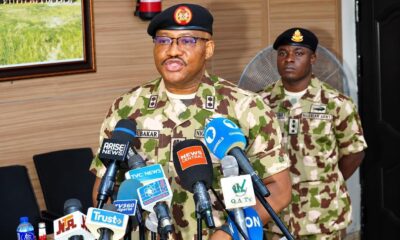
The figures were disclosed on Monday by the Director of Defence Media Operations, Major General Michael Onoja, at the monthly briefing on military operations in Abuja.
The operations, which stretched across the forests of the North-West and North-Central, conflict-affected communities in the North-East and the oil-producing creeks of the South-South, involved ground assaults, intelligence-led raids, aerial surveillance and coordinated operations with other security agencies.
Among the major successes recorded during the month was the rescue of 15 NYSC members and six other abducted persons, as troops intensified efforts to dismantle kidnapping networks and secure communities, major highways and other vulnerable locations.

308 Victims Rescued in Kainji Lake Operation
One of the biggest rescue operations of the month occurred on August 5 when troops operating around the Kainji Lake National Park rescued 308 abducted persons, mainly women and children.
The victims included 163 indigenes of Woro community in Kwara State and 145 persons from Niger State.
According to the Defence Headquarters, the operation was made possible through intelligence sharing and coordination among security agencies and relevant government institutions.
Troops, however, continued operations around the national park and other identified routes to prevent terrorists and kidnappers from re-establishing safe havens in the area.
Military Steps Up Offensive Nationwide
In the North-East, Operation HADIN KAI rescued 60 kidnap victims, neutralised 114 terrorists and arrested 146 suspects.
Some of those rescued had reportedly spent months and years in captivity.
Among them was 18-year-old Blessing Tuggur, who was abducted in November 2025 and rescued in August.
Troops also rescued women and children from terrorist enclaves around Gwoza and the Mandara Mountains.
The military further reported that 201 insurgents surrendered during the month, attributing the development to sustained military pressure, shortages of food and supplies, insecurity within terrorist camps and clashes among rival terrorist factions.

North-West Operations Hit Terrorist Networks
In the North-West, Operation FANSAN YAMMA intensified operations across Kaduna, Katsina, Sokoto and Zamfara states.
The operation resulted in the rescue of 126 victims, neutralisation of 190 terrorists and arrest of 47 suspects.
On August 28, troops conducting clearance operations around Maikujera in Sokoto State neutralised 30 terrorists.
The military said the terrorists were suspected to be connected to the network of terrorist kingpin, Bello Turji.
Air operations also supported the ground campaign, with military aircraft conducting reconnaissance and strikes against terrorist concentrations in Niger State. One of the operations reportedly resulted in the neutralisation of 46 terrorists.
329 Kidnap Victims Rescued in North-Central
The North-Central recorded significant gains, particularly in the fight against kidnapping and attacks on rural communities.
Under Operation SAVANNAH SHIELD, troops rescued 329 victims across Kwara and Niger states, representing more than half of the military’s total rescue figure for August.
The operation also led to the rescue of the Onigbesi of Igbesi Kingdom, Oba Moses Oyinloye Iwedunmoye I, alongside two women in Kwara State.
Meanwhile, Operation WHIRL STROKE, covering Benue, Kogi, Nasarawa and Taraba states, rescued 38 victims.
In Kogi State, troops and local security personnel rescued 16 victims comprising six men, six women and four children.
Nine more victims were rescued after troops intercepted vehicles belonging to suspected kidnappers, while another 13 victims escaped captivity following sustained military pressure.
Casualties Highlight Continuing Security Threat
Despite the reported successes, the military also recorded casualties during engagements with terrorists and armed criminal groups.
In Kebbi State, some local security personnel and a civilian were killed during an encounter with terrorists, while a civilian was also killed in Benue State in an attack blamed on suspected armed herders.
The military leadership expressed condolences to the families of those who lost their loved ones.
The casualties, however, underscore the continuing dangers posed by terrorism, kidnapping and armed violence despite the military’s operational gains.
Troops Target Terrorist Supply Chains
Beyond direct engagements with terrorists, troops also targeted the networks responsible for supplying armed groups with weapons, ammunition, money, intelligence and other logistics.
Suspected logistics suppliers, informants, couriers and gunrunners were arrested across the operational theatres.
The military recovered 88 assorted arms and 2,077 rounds of ammunition, while several terrorist hideouts and supply routes were dismantled.
Operations in the North-East, North-West and North-Central also disrupted the movement of explosives, firearms, motorcycles and other supplies reportedly destined for criminal and terrorist groups.
Military Intensifies War Against Oil Theft
In the Niger Delta, Operation DELTA SAFE focused on crude oil theft, illegal bunkering and illegal refining activities.
The military said it recovered 686,800 litres of stolen petroleum products and destroyed 21 illegal refining sites during the month.
Troops also discovered suspected stolen crude oil and illegally refined products stored in pits, reservoirs, boats and concealed locations.
The military said the operations were aimed at combating criminality, protecting critical petroleum infrastructure and safeguarding the country’s economic interests.
Security Operations Extend Beyond the Battlefield
The military also intensified its non-kinetic interventions, recognising the importance of community engagement in achieving lasting peace.
In Benue, troops facilitated peace and security meetings among ethnic groups, while in Borno, educational materials were donated to schools in Monguno.
Military personnel also worked with humanitarian organisations to secure relief corridors and facilitate access to communities affected by conflict.
The Nigerian Navy, meanwhile, commissioned a solar-powered water project in Lagos.
These initiatives formed part of efforts to complement military operations with humanitarian assistance, community engagement and confidence-building.
The Challenge Beyond the Statistics
While the August figures point to significant operational gains, they equally demonstrate the scale of Nigeria’s security challenges.
The rescue of 610 victims represents hundreds of kidnapping incidents that occurred across the country.
Similarly, the large number of terrorists neutralised or arrested indicates that criminal and terrorist groups continue to possess the capacity to recruit, organise and operate across difficult terrain.
The surrender of 201 insurgents, however, provides a potentially positive sign that sustained military pressure is weakening some terrorist networks and encouraging fighters to abandon their enclaves.
The next major challenge for the security forces will be to ensure that rescued communities remain protected, displaced persons safely return home and terrorist groups are prevented from relocating to new operational corridors.
The Chief of Defence Staff, General Olufemi Olatubosun Oluyede, has pledged to sustain the offensive until peace and stability are consolidated.
For Nigerians, however, the real measure of the military’s success will ultimately go beyond the statistics: families being able to sleep without fear, farmers returning safely to their fields, children going to school and communities reclaiming their lives from the grip of kidnapping and terrorism.