By EL-Sabo Ibn Nas
The political atmosphere in Adamawa State has become increasingly tense following a major dispute within the African Democratic Congress (ADC) over the governorship ticket of Ambassador Engineer Omar Suleiman, popularly known as Omarana.
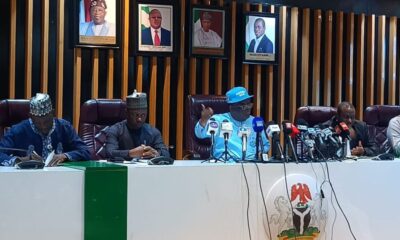
The crisis escalated on Thursday in Yola, where ADC stakeholders, youth groups and women support organisations converged to demand that the party’s National Working Committee immediately address allegations of an attempt to substitute Omar Suleiman as the party’s governorship candidate.
The groups subsequently issued a 48-hour ultimatum to the national leadership, insisting that the mandate freely secured by Omarana must not be altered through what they described as a “backdoor” arrangement.
At the centre of the controversy is an alleged attempt to manipulate or alter the Independent National Electoral Commission (INEC) candidate portal and replace the name of the candidate said to have emerged from the party’s validly conducted primary election.
The development has reignited concerns about the growing influence of internal party manoeuvring in Nigeria’s electoral process, particularly allegations that candidates can be replaced through administrative arrangements after securing the support of party members and delegates.
For the Adamawa stakeholders, however, the issue goes beyond an ordinary disagreement over a party ticket.
They argue that Omarana’s mandate was built on broad grassroots support across the state’s 21 local government areas and should therefore not be subjected to what they regard as arbitrary decisions by individuals operating from Abuja.
According to the stakeholders, any attempt to replace the candidate without the consent of the party’s legitimate structures in Adamawa would amount to an assault on the democratic will of the party’s members.
The dispute is unfolding against the backdrop of significant changes in Adamawa’s political landscape.
The recent movement of Governor Ahmadu Umaru Fintiri into the All Progressives Congress (APC) has altered existing political calculations in the state and created a new alignment involving several major political interests.
The development has also intensified speculation about possible power struggles involving established political figures and emerging political platforms ahead of the 2027 general elections.
Against this backdrop, the ADC has increasingly positioned itself as a potential alternative platform for voters seeking to break away from the traditional political establishments.
Omar Suleiman’s emergence as a leading figure within the party has therefore attracted considerable attention, particularly because of his professional background and public profile.
A former Managing Director of the Nigerian Ports Authority (NPA) and diplomat, Omar Suleiman has built his political message around economic development, job creation, infrastructure and the use of professional expertise to address the state’s development challenges.
His supporters contend that his growing acceptance among the electorate is responsible for the alleged efforts to undermine his candidacy.
They have consequently vowed to resist any attempt to replace him with what they described as a “pliable proxy” imposed by forces outside the state.
Questions for ADC Leadership
The controversy has also raised questions about the position of prominent figures within the opposition coalition, particularly former Vice President Atiku Abubakar.
Supporters of Omarana are demanding to know why Atiku, whom they regard as one of the country’s leading advocates of democratic principles, has not publicly intervened in the controversy.
They argue that silence from prominent opposition leaders could further deepen suspicion among grassroots supporters who believe that their mandate is being threatened.
Attention has also shifted to the national leadership of the ADC, including National Chairman Senator David Mark and National Secretary Ogbeni Rauf Aregbesola.
The stakeholders want the national leadership to provide clear assurances that the outcome of the Adamawa governorship primary will be respected and that no unauthorised alteration will be made to the party’s candidate on the INEC platform.
48-Hour Deadline
The 48-hour ultimatum issued in Yola represents the strongest indication yet of the level of resistance building within the Adamawa chapter of the ADC.
The stakeholders warned that any attempt to tamper with the governorship ticket could have serious consequences for the party’s structure in the Northeast.
They maintained that the ADC’s strength in the region depends largely on the confidence of its grassroots members and that any perception of an imposed candidate could trigger widespread disenchantment.
For them, the message to the national leadership is straightforward: the Adamawa governorship ticket should reflect the outcome of the party’s internal democratic process and not the preferences of political actors operating outside the state.
The controversy has also placed the burden of clarification on the ADC hierarchy.
Rather than allowing speculation to fester, the party leadership, the stakeholders argue, should publicly clarify the status of its Adamawa governorship candidate and demonstrate that the name submitted to INEC reflects the legitimate outcome of the party’s primary election.
As the 48-hour deadline approaches, Adamawa is now watching closely to see whether the dispute will be resolved through dialogue or escalate into a larger confrontation within the opposition party.
For Omarana’s supporters, the battle is no longer simply about one candidate. It is about whether a grassroots mandate can withstand the influence of national-level political calculations.
The coming days may therefore determine whether the ADC can consolidate its emerging structure in Adamawa—or become another casualty of the internal power struggles that have historically weakened opposition politics in Nigeria.