

Featured By Matthew Otabe
For decades, Nigeria’s energy industry was a story of enormous potential constrained by policy uncertainty, declining investments, ageing infrastructure and missed opportunities. Today, government officials and industry leaders insist that narrative is changing.
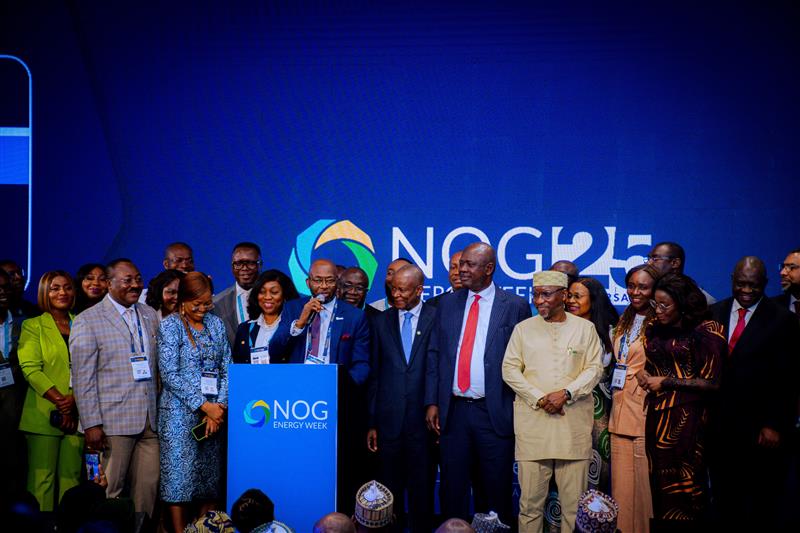
That message dominated the 2026 Nigerian Oil and Gas (NOG) Energy Week in Abuja, where policymakers, regulators and industry executives painted a picture of an industry they believe is moving from recovery to expansion.
Twenty-five years after the conference was first conceived to provide a platform for dialogue, the discussions have evolved beyond oil production targets.
They now revolve around investment, energy security, industrialisation, regional integration and Nigeria’s place in an increasingly competitive global energy market.
Oil Production Rebounds
Minister of State for Petroleum Resources (Oil), Heineken Lokpobiri, said the industry’s recent gains are the result of coordinated reforms under President Bola Tinubu’s administration.
According to him, Nigeria has increased crude oil production from about one million barrels per day in 2023 to over 1.8 million barrels daily, including condensates.
While describing the achievement as significant, Lokpobiri maintained that it should only be viewed as a milestone rather than the destination.
Having previously produced 2.5 million barrels per day, he argued that Nigeria possesses the capacity to attain such levels again through sustained investment and closer collaboration across the sector.

The minister revealed that active drilling rigs have increased from about 14 in 2023 to more than 60, describing the expansion as critical to sustaining future production growth and reserve replacement.
For him, the increase in drilling activity signals renewed investor confidence after years of limited upstream investment.
Indigenous Companies Take Centre Stage
One of the biggest structural shifts in Nigeria’s petroleum industry has been the transfer of onshore assets from international oil companies to indigenous operators.
Lokpobiri said government support for divestments has transformed local firms into the dominant force in domestic production.
Companies such as Renaissance, Seplat and Oando, he noted, have expanded production after acquiring assets previously operated by Shell, ExxonMobil and ENI.
According to the minister, indigenous companies now account for more than 60 per cent of Nigeria’s daily crude production.
Rather than signalling the departure of international companies, he argued, the divestments have enabled them to concentrate on deepwater exploration where they possess comparative advantages.
The outcome, he said, is a more balanced industry in which local firms drive onshore production while international operators pursue frontier deepwater opportunities capable of expanding Nigeria’s reserves.
From Energy Transition to Energy Mix
Another major theme running through the conference was Nigeria’s continued opposition to what officials describe as an unfair global energy transition agenda.
Lokpobiri argued that the conversation has shifted globally from abandoning fossil fuels to embracing an “energy mix” that balances hydrocarbons with cleaner energy sources.
He maintained that developed countries, which account for the overwhelming majority of global emissions, cannot expect African countries responsible for only a small fraction of emissions to halt the development of their oil and gas resources.
For Nigeria, he said, oil revenues remain essential for industrialisation, infrastructure development and economic transformation.
Gas Emerges as Nigeria’s Economic Engine
While oil remains central to government revenue, the administration is placing increasing emphasis on natural gas as the fuel expected to drive long-term economic growth.
Minister of State for Petroleum Resources (Gas), Ekperikpe Ekpo, described natural gas as the bridge between energy security and sustainability.With about 215 trillion cubic feet of proven gas reserves—the largest in Africa—Nigeria, he said, is positioning itself not merely as a resource-rich country but as a gas-powered economy.
Ekpo said reforms introduced under the Petroleum Industry Act and subsequent executive orders have created greater regulatory certainty, shortened contracting timelines and improved incentives for gas investment.
He said the country’s strategy extends beyond exports to domestic industrialisation.
Under the Decade of Gas initiative, government is promoting gas utilisation for electricity generation, fertiliser production, petrochemicals, transportation and clean cooking.
According to him, every additional cubic foot consumed domestically translates into jobs, industrial output and reduced dependence on imports.
Infrastructure Becomes the Missing Link
Industry leaders repeatedly stressed that reserves alone cannot transform an economy without infrastructure.
Ekpo highlighted progress on major gas projects including the OB3 pipeline and the Ajaokuta-Kaduna-Kano (AKK) pipeline, describing both as vital to integrating Nigeria’s domestic gas network.The pipelines are expected to transport gas from producing fields in southern Nigeria to industries and power plants in the northern and western parts of the country.
Additional processing plants, he said, are also helping reduce gas flaring while increasing supplies of liquefied petroleum gas and condensates for local industries.
Government is equally pushing domestic programmes including the Presidential Compressed Natural Gas initiative and the National Clean Cooking Programme aimed at reducing household energy costs and expanding access to cleaner fuels.
Nigeria Eyes Global Gas Leadership
The government’s ambitions extend beyond domestic markets.Ekpo noted that Nigeria recently assumed the presidency of the Gas Exporting Countries Forum ministerial meeting while a Nigerian was elected Secretary-General of the organisation.
He also cited Nigeria’s admission as an association country of the International Energy Agency as evidence of growing international recognition.
These developments, he said, position Nigeria to influence global conversations on energy security while defending the interests of developing countries seeking to utilise their natural resources responsibly.
At the same time, Nigeria is advancing regional infrastructure projects including the Trans-Saharan Gas Pipeline, the African Atlantic Gas Pipeline and expanded West African gas networks.Officials believe such projects could strengthen regional integration while opening new export markets across Africa and Europe.
NNPC Pushes a New Corporate Culture
Group Chief Executive Officer of NNPC Limited, Bayo Ojulari, argued that no amount of natural resources can deliver prosperity without collaboration.
According to him, Africa’s greatest challenge is not a shortage of hydrocarbons but fragmentation between governments, investors, regulators, researchers and financial institutions.
He called for stronger partnerships capable of connecting policy, capital, technology and innovation. Within NNPC itself, Ojulari said reforms are focused on transparency, accountability and commercial discipline.
He disclosed that pipeline availability has improved significantly through collaboration with host communities and security agencies rather than relying solely on military protection.
He also said NNPC has prioritised prompt settlement of joint venture cash calls, eliminated non-performing projects and introduced infrastructure financing models tied directly to project revenues.
The company’s objective, he explained, is to evolve from a traditional oil producer into an integrated energy ecosystem builder connecting finance, infrastructure, technology and markets.
A New Chapter?
Despite the optimism, officials acknowledge that challenges remain. Nigeria still faces infrastructure deficits, financing constraints, regulatory complexities and global market uncertainties.
However, the message from this year’s Energy Week was unmistakable. Government believes the Petroleum Industry Act, executive reforms, indigenous participation, renewed drilling, gas infrastructure and deeper collaboration have created the foundation for a more competitive energy sector.
Whether these ambitions translate into sustained production growth, industrial development and broader economic prosperity will depend on consistent implementation.
For now, the industry appears united around one conviction: Nigeria’s energy future will be shaped not simply by the size of its oil and gas reserves, but by its ability to convert those resources into investment, jobs, industrial growth and shared national prosperity.
Otabe is the CEO/Publisher of FirmNews



But let the common feel the impact