


By Matthew Otabe
The Minister of Defence, General Christopher Gwabin Musa (retd.), has called on Nigeria to move beyond consuming foreign technology and develop indigenous capabilities to support its military operations and national security requirements.
Musa said the country must prioritise technology transfer, local expertise and manufacturing as part of efforts to modernise the Armed Forces and strengthen its response to emerging security threats.
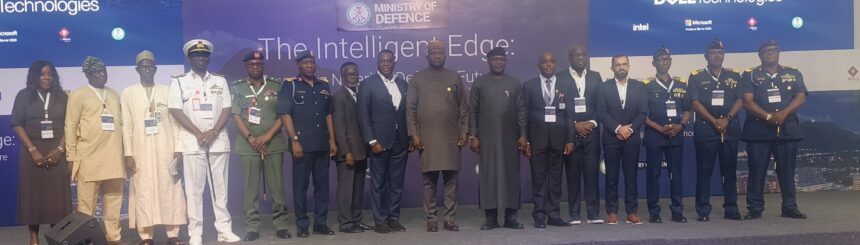
The minister made the call on Tuesday at the opening of a two-day strategic workshop jointly organised by the Ministry of Defence and Dell Technologies at the Armed Forces Officers’ Mess, Asokoro, Abuja.
The workshop, themed “The Intelligent Edge: Powering Nigeria’s Defence Future,” is aimed at exploring how emerging technologies can improve military operations, intelligence gathering and decision-making.
Musa said advancements in artificial intelligence, data analytics and digital systems were significantly changing the character of warfare, making technology indispensable to modern defence operations.
“Technology is no longer optional. It is essential to improving all aspects of strategy and operations, including enabling commanders to make better-informed decisions,” he said.
He stressed that Nigeria must develop the capacity to operate, maintain, adapt and, where feasible, manufacture technologies suited to its national requirements.
According to him, partnerships with reputable international technology companies should provide opportunities for knowledge transfer, technical training and the development of indigenous expertise.
“I encourage participants to examine how this partnership can support technology transfer, local capacity building and manufacturing,” he said.
The minister added that the technical knowledge and skills developed through such engagements should also contribute to national development by preparing young Nigerians for opportunities in a technology-driven economy.
Musa urged participants to focus on practical solutions that could be implemented to address the Ministry’s technological requirements and existing capacity gaps.
He said the workshop should produce clear areas of action rather than merely presentations and recommendations.
The minister said the joint communiqué expected at the end of the engagement should capture key agreements, priority requirements and actionable recommendations to guide implementation.
He assured participants that the Ministry would assess the recommendations to identify areas requiring intervention.
Musa reaffirmed the Ministry’s commitment to partnerships that strengthen national security institutions and enhance Nigeria’s defence capabilities, adding that the initiative aligned with President Bola Tinubu’s vision of a safer and more secure country.
Military seeks integrated digital infrastructure
The Special Adviser on Technology to the Minister of Defence, Air Vice Marshal Amos Bulus, said the initiative, which began in February 2026, was designed to promote technological advancement and institutional development within the defence sector.
Bulus commended the minister for his leadership and commitment to technological transformation, while appreciating Dell Technologies for partnering with the Ministry.
He said the collaboration was intended to provide access to technology solutions, promote knowledge transfer, develop institutional capacity and identify sustainable technologies suited to Nigeria’s defence requirements.
According to him, the workshop would provide a secure environment for discussions on military capabilities, defence infrastructure, operational requirements and institutional capacity gaps.
He explained that the engagement would also enable military personnel, policymakers, technical experts and industry partners to examine challenges affecting the effective deployment of technology in the defence sector.
Bulus said the workshop would focus on how secure computing infrastructure, data management, cybersecurity and integrated technology solutions could improve coordination among the Armed Forces, strengthen personnel records and enhance the management of institutional workflows.
He expressed optimism that the initiative would support the development of a more integrated, responsive and technology-driven defence ecosystem.
In his goodwill message, the Country Lead of Dell Technologies in Nigeria, Abimbola Owoeye, called for a shift from technology expenditure to strategic investment in digital infrastructure.
Owoeye said the workshop was designed to examine the digital foundation Nigeria’s defence establishment would require over the next decade and beyond.
He stressed the need for integrated data platforms, intelligent automation and improved data management systems to enhance military capabilities.
According to him, data has become central to intelligence and decision-making across sectors, including healthcare, public administration, public security and the military.
“We are as intelligent as the data we have access to,” he said.
Owoeye challenged participants to consider how quickly relevant data could be accessed, how securely it could be stored and how effectively intelligence could be derived from it.
He said the workshop would examine the role of computing, storage systems, data centres and artificial intelligence in processing, securing and analysing information to support proactive decision-making.
The Dell executive said the engagement would also showcase technological solutions deployed in other environments and explore how they could be adapted to meet Nigeria’s specific defence requirements.
He assured the Ministry of Dell Technologies’ commitment to working with local stakeholders to develop practical solutions and promote indigenous innovation.
The workshop is expected to bring together senior military officials, defence technology experts, policymakers and industry stakeholders to explore digital solutions for improving operational effectiveness and strengthening Nigeria’s national security.