

By Matthew Denis
Nigeria and Russia have strengthened bilateral customs relations with the signing of a cooperation agreement designed to facilitate legitimate trade, enhance intelligence sharing and improve border security between the two countries.
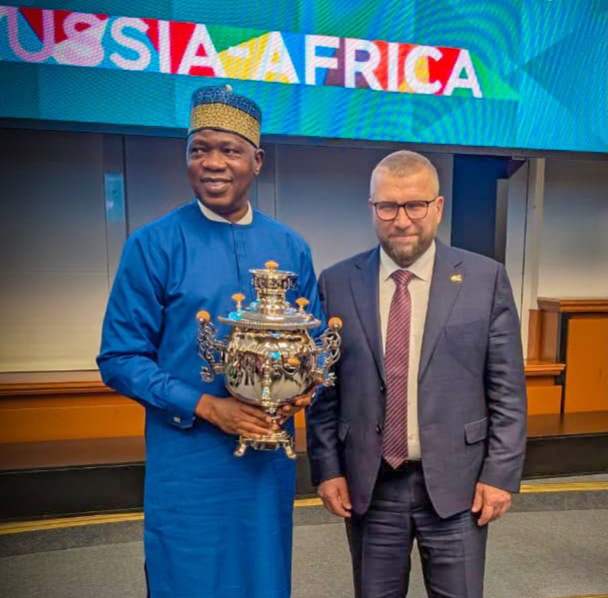
The agreement, known as the Agreement on Cooperation and Mutual Assistance in Customs Matters (CMAA), was signed by the Nigeria Customs Service (NCS) and the Federal Customs Service of the Russian Federation in Moscow on October 28, 2026.
The pact establishes a framework for enhanced collaboration in trade facilitation, customs enforcement, information exchange, financial integrity and capacity development, while opening new opportunities for operational cooperation between the two administrations.
The Comptroller-General of Customs, Adewale Adeniyi, who led the Nigerian delegation, described the agreement as a strategic instrument for safeguarding economic integrity, securing international supply chains and strengthening trade governance.
Adeniyi said the agreement followed months of technical consultations, legal reviews and constructive engagements between both administrations, demonstrating their shared determination to modernise customs operations and address emerging challenges in international trade.
He explained that the Nigeria Customs Service had accelerated its institutional transformation through the adoption of digital technologies, which have significantly automated customs operations.
According to him, declarations, payments and the submission of supporting documents are increasingly handled electronically, improving operational efficiency and making legitimate trade easier.
The Customs chief stressed that revenue generation and trade facilitation were complementary objectives rather than competing priorities, noting that the NCS approach was consistent with the World Customs Organisation’s SAFE Framework of Standards.
On the implementation of the agreement, Adeniyi identified the exchange of experiences between the two countries’ Authorised Economic Operator (AEO) programmes as a major area of cooperation.
He said both administrations would undertake structured engagements to understand their respective AEO frameworks, operational procedures and implementation experiences, with the long-term objective of achieving mutual recognition and acceptance.
He noted that mutual recognition of the programmes would strengthen confidence in compliant businesses and potentially accelerate cargo clearance and movement between the two countries.
During bilateral discussions with the Head of the Federal Customs Service of Russia, Valery Pikalyov, Adeniyi highlighted similarities in the reform trajectories of both customs administrations.
He explained that the Nigeria Customs Service had evolved significantly from its colonial origins into a modern customs institution, particularly following the enactment of the Nigeria Customs Service Act 2023.
According to him, the legislation provided a stronger legal foundation for institutional reforms, technological advancement and partnerships with the private sector.
The discussions also explored opportunities for sharing customs statistics and trade data to improve analysis of commercial activities between both countries.
Adeniyi disclosed that Nigeria was participating in the World Customs Organisation’s data initiative, noting that the NCS was the only customs administration to have submitted its trade data to the WCO data project.
He said access to reliable customs statistics and structured information exchange would enhance comparative analysis, provide better understanding of bilateral trade patterns and strengthen evidence-based decision-making.
Responding, Pikalyov explained that the Russian Federal Customs Service had statutory responsibility for collecting, processing, compiling and providing customs statistics derived from customs declarations.
He disclosed that Russia already exchanged customs statistics with foreign customs administrations under existing bilateral agreements, enabling participating countries to analyse trade flows, identify discrepancies and monitor developments in commercial relations.
Pikalyov indicated Russia’s readiness to explore a dedicated statistical data-sharing arrangement with the Nigeria Customs Service, subject to the relevant legal framework and operational procedures.
The Russian delegation also noted that Nigeria had become one of the first sub-Saharan African countries, alongside Ethiopia and Namibia, to conclude a customs cooperation agreement with the Federal Customs Service of Russia.
The engagement was held within the framework of the Third Russia-Africa Summit, providing an opportunity to strengthen customs collaboration as part of the broader bilateral relationship between both countries.
The CMAA identifies four major areas of cooperation, including the simplification of customs procedures to facilitate legitimate trade and secure information exchange to prevent, detect, investigate and suppress customs-related offences.
It also provides for financial integrity measures targeting illicit financial flows, grey-market importations and tax evasion, as well as stronger border security through joint efforts against counterfeit products, narcotic drugs, psychotropic substances and other prohibited or hazardous materials.
Additionally, the agreement provides a legal framework for direct engagement between the two customs administrations on operational assistance, personnel training and the exchange of professional experience.
With the agreement signed, both countries are expected to deepen institutional cooperation, strengthen customs intelligence, promote compliant businesses and contribute to safer, faster and more efficient international supply chains.