

By Matthew Denis
The Nigeria Customs Service (NCS) has intensified efforts to improve trade facilitation, strengthen revenue generation and address operational bottlenecks in its B’Odogwu Unified Customs Management System following a three-day technical review workshop in Lisbon, Portugal.
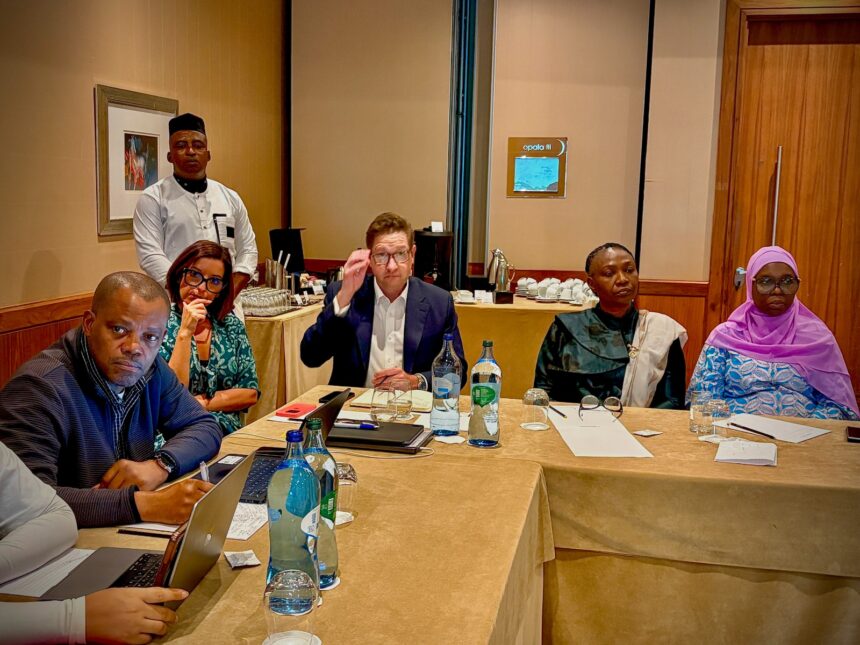
The workshop, held from November 9 to 11, 2026, at the Corinthia Hotel, brought together NCS management and officers, Trade Modernisation Project Limited (TMPL) and CB-XP representatives to assess the system’s performance and develop strategies for improving its efficiency.
The review produced key resolutions targeting faster cargo clearance, improved electronic cargo tracking, stronger transit and bond management, and enhanced revenue collection.
Speaking at the opening ceremony, the Deputy Comptroller-General of Customs in charge of ICT Modernisation, Oluyomi Adebakin, commended the Comptroller-General of Customs, Adewale Adeniyi, for his commitment to technological innovation and capacity development within the Service.
Similarly, the Managing Director of TMPL, Jummai Umar-Ajijola, who represented the company’s Chairman, Saleh Ahmadu, disclosed that the B’Odogwu platform had attracted interest from the African Continental Free Trade Area (AfCFTA) Secretariat.
She noted that continuous improvements to the platform had contributed to increased revenue generation and strengthened Nigeria’s customs revenue ecosystem.
Umar-Ajijola said the workshop provided an opportunity to consolidate achievements recorded over the past three years and develop a clear roadmap for the system’s future development.
“We are to work to find a concrete plan not only to consolidate but to build a change roadmap going forward at the assessment of the three years so far,” she said.
She also acknowledged the contributions of the NCS Public Relations Unit in sustaining public awareness and reporting on the project’s implementation.
Among the major resolutions reached was the upgrading of the Electronic Cargo Tracking System (ECTS), alongside improvements in bond and transit management and automation of customs procedure code approvals.
Participants also agreed on the need to streamline the processing of import, export, re-importation and transit declarations while harmonising procedure code nomenclature to promote uniformity, transparency and accountability across customs operations.
On cargo security and monitoring, the workshop examined plans to integrate the upgraded ECTS with B’Odogwu and replace 200 obsolete electronic seals with 2,000 newly procured units.
The proposed improvements are also expected to strengthen individual container tracking for applicable transit declarations, enhance bond registration and validation, and tighten monitoring of bonded cargo movements to reduce diversion.
The workshop further considered integrating B’Odogwu with the Nigeria Export Processing Zones Authority (NEPZA), improving the Transire Processing System and upgrading the platform’s reporting dashboard.
Other technical interventions identified included improved search filters, enhanced Harmonised System (HS) Code search functionality, access to previously processed declarations and better monitoring of procedure code applications.
Participants also recommended introducing system alerts to minimise processing errors and incorporating Time Release Study requirements to improve the measurement of cargo clearance efficiency.
In addition, Standard Operating Procedures (SOPs) governing Bond Management, Transire Commands and Export Commands were reviewed to ensure alignment with the Nigeria Customs Service Act 2023.
To strengthen project governance, the workshop resolved that all requests for system modifications must undergo review and receive approval from the Officer in Charge of the Project Management Office before deployment.
The project’s communication plan was also reviewed as part of efforts to improve stakeholder engagement and ensure effective communication throughout the implementation process.
At the closing ceremony on November 11, the Deputy Comptroller-General of Customs in charge of Finance, Administration and Technical Services (FATS), Kikelomo Adeola, stressed the importance of translating the workshop’s resolutions into measurable operational improvements.
The ceremony featured a presentation by the Customs Area Controller, Comptroller Murtala Mu’azu, while the Chairman of CB-XP, Edward Bowen, delivered goodwill remarks.
To ensure effective implementation, specific responsibilities were assigned to relevant NCS and TMPL units, with emphasis on translating the agreed technical and operational recommendations into practical improvements.
The review underscores the Service’s determination to strengthen the B’Odogwu platform as a major instrument for modernising customs operations, facilitating legitimate trade, improving cargo visibility and optimising government revenue.