


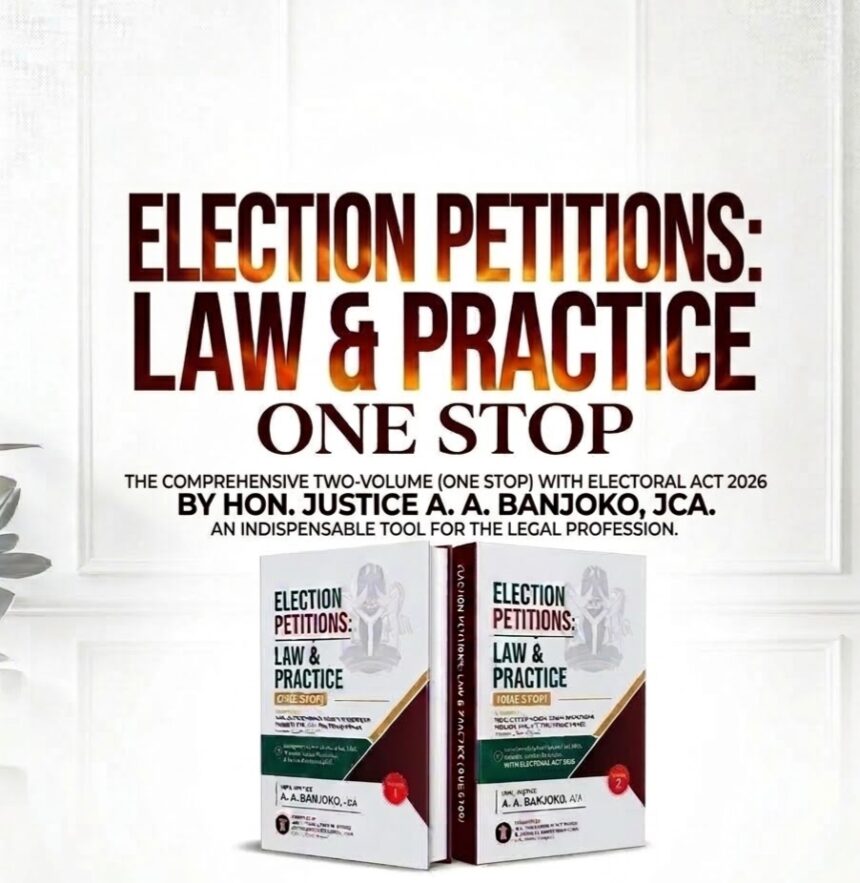
The two-volume publication titled Election Petition: Law & Practice (One-Stop), authored by Honourable Justice A. A. Banjoko, has been described as a timely and significant contribution to legal scholarship and the development of electoral jurisprudence in Nigeria.
The commendation was made by Professor Yemi Akinseye-George, SAN, FNIALS, FCIArb, who noted that the books provide a comprehensive and practical examination of the legal principles, procedures and judicial decisions governing election petitions and pre-election matters in the country.
According to him, the publication addresses some of the most challenging and technical aspects of electoral litigation, offering legal practitioners, judicial officers, researchers and other stakeholders an accessible reference material for understanding and navigating electoral disputes.
The two volumes examine different but interconnected aspects of electoral litigation in Nigeria.
Volume One, which comprises 13 chapters, focuses extensively on pre-election matters, including political parties, party primaries, nomination and substitution of candidates, qualification and disqualification, locus standi, jurisdiction and other disputes arising before elections.
Volume Two, comprising 14 chapters, deals comprehensively with election petitions, covering grounds for challenging election results, substantial non-compliance, corrupt practices, over-voting, improper accreditation, exclusion of lawful votes, electoral malpractice, burden and standard of proof, admissibility of evidence, as well as procedural and statutory requirements governing election petition proceedings.
Akinseye-George particularly highlighted the extensive discussion of digital evidence in Chapter 13, describing it as an important feature that reflects the growing influence of technology in contemporary electoral litigation.
He also identified the detailed examination of the Electoral Act 2026 as one of the publication’s major strengths, noting that its comparative analysis of the 2022 and 2026 Electoral Acts provides useful insights into key amendments, innovations and their implications for electoral administration and dispute resolution.
The books, he added, are enriched by discussions of notable judicial decisions, including relevant 2026 pronouncements of the Supreme Court and Court of Appeal.
He observed that the integration of statutory provisions, judicial precedents and scholarly perspectives gives readers a deeper understanding of the interpretation and application of electoral laws in resolving disputes.
According to the senior lawyer, the major strength of the publication lies in its comprehensive coverage, practical orientation and accessibility, which collectively fulfil the One-Stop concept of providing a single reference source for research, legal interpretation and professional practice.
He described the books as invaluable resources for judges, members of election petition tribunals, legal practitioners, Senior Advocates of Nigeria, law students, academics, researchers, political parties, candidates and electoral administrators.
In his concluding remarks, Akinseye-George said the publication goes beyond a mere exposition of electoral law, describing it as an important professional and academic resource for legal research, effective advocacy, sound judicial decision-making and the advancement of electoral justice in Nigeria.
He recommended the two volumes to all stakeholders in the country’s electoral and judicial systems, stressing that they deserve a place in every law library, judicial chamber and legal practitioner’s office.
By Prof. Yemi Akinseye-George, SAN, FNIALS, FCIArb.