

By Matthew Denis
The Economic Community of West African States (ECOWAS) has set a target of achieving 100 per cent rice self-sufficiency across the West African sub-region by 2035, as part of efforts to strengthen food security, boost agricultural production and reduce dependence on rice imports.
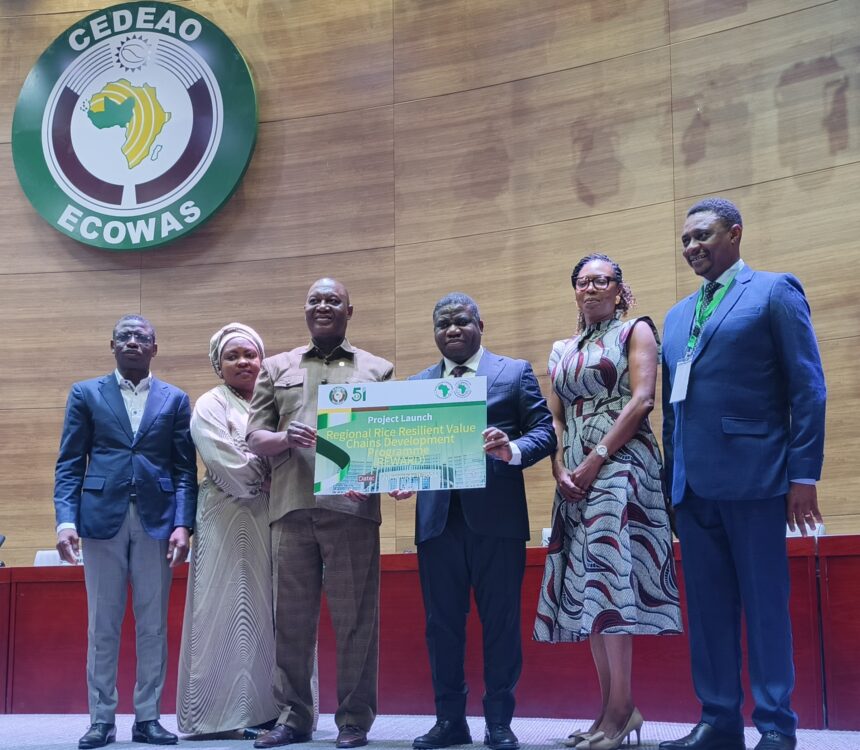
The ECOWAS Commission disclosed this on Wednesday, November 11, 2026, during the official launch of the Regional Rice Resilient Value Chains Development Programme (REWARD) and its Steering Committee at the Commission’s New Headquarters, Airport Road, Abuja.
Speaking at the event, the ECOWAS Commissioner for Economic Affairs and Agriculture, Mr. Dehpue Yenpea Zuo, said the programme was designed to improve access to financing for farmers, strengthen rice production and develop the entire rice value chain across the sub-region.

Yenpea said the overall investment portfolio for the initiative was estimated at about $25 billion, while $1.5 billion had so far been mobilised in firm commitments from development partners and private-sector investors.
He explained that the funding commitment emerged from the Regional Rice Roundtable and Financing Conference held in Accra, Ghana, adding that the resources would support farmers, businesses and other stakeholders involved in rice production and processing.
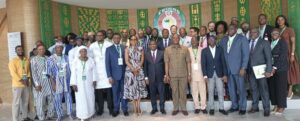
According to him, the launch of the Steering Committee marked an important step towards ensuring effective implementation, coordination and oversight of the programme.
He noted that ECOWAS Heads of State and Government had mandated the Commission to promote rice production and ensure adequate availability and affordability of the commodity across West Africa.
Yenpea called on governments, private-sector operators, development partners and individuals with the capacity to invest in agriculture to support the initiative.
He said achieving rice self-sufficiency would require collective commitment and stronger partnerships among governments, farmers, investors and other stakeholders.
Also speaking, the Coordinator of the ECOWAS Rice Agenda and REWARD Project, Bola Dale Adebowale, described rice as a strategic staple crop whose development was critical to food security and economic stability in West Africa.
Adebowale said the REWARD programme was one of the major instruments through which ECOWAS was implementing its regional rice development agenda.
He explained that the Steering Committee would provide strategic direction and guidance for the implementation of the programme across participating countries.
According to him, West Africa currently meets about 60 per cent of its rice requirements through local production, but the regional target is to achieve 100 per cent self-sufficiency by 2035.
He said the sub-region would need to produce approximately 35 million metric tonnes of rice annually by that period to meet projected consumption demand.
Adebowale, however, observed that the increasing population across West Africa made it necessary to build a more productive, competitive and sustainable rice sector capable of responding to growing demand.
He stressed that improving production alone would not be sufficient, noting that investments were also required in processing facilities, market systems and regional trade infrastructure.
The coordinator said ECOWAS had established the Rice Observatory to coordinate interventions, investments and activities in the regional rice sector, ensuring better collaboration among governments, development partners and private-sector operators.
He described the mobilisation of $1.5 billion in firm investment commitments at the Accra Regional Rice Roundtable as a significant milestone towards translating the regional rice agenda into concrete action.
Adebowale added that the commitment demonstrated that ECOWAS and its partners were prepared to back their agricultural development objectives with the necessary financial resources.
On the geographical coverage of the REWARD programme, he explained that it was designed to cover all ECOWAS member states, although implementation was being introduced in phases.
He identified Côte d’Ivoire, Guinea-Bissau, The Gambia, Mali and Senegal as the countries in the first group that had commenced implementation.
He said additional countries were expected to join the programme in the first quarter of 2027, while the number of participating countries was projected to reach close to 10 by the end of next year.
Adebowale clarified that Nigeria was not among the first-group countries but was expected to join the programme in 2027.
He expressed optimism that successful implementation of the rice development initiative would provide a model for strengthening other agricultural value chains and improving food security across the West African region.