


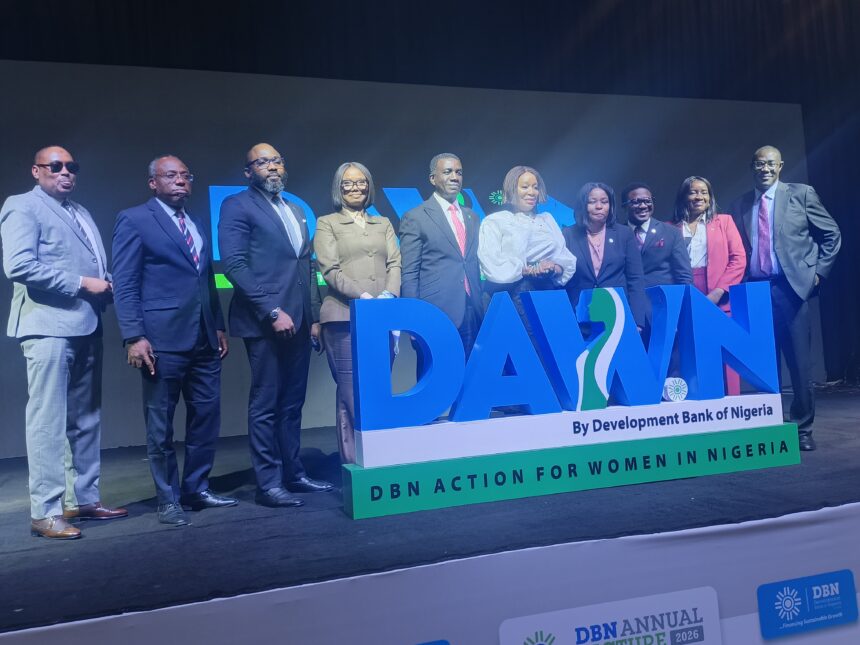
The Development Bank of Nigeria (DBN) has disbursed a cumulative ₦1.4 trillion to micro, small and medium enterprises (MSMEs) through 84 participating financial institutions as of December 2025, supporting the creation of more than 1.6 million jobs nationwide.
The bank also unveiled a new five-year strategy targeting more than two million businesses, with particular emphasis on women-led enterprises, youth entrepreneurs and underserved segments of the economy.
The Managing Director and Chief Executive Officer of DBN, Dr. Tony Okpanachi, disclosed this at the sixth edition of the bank’s annual lecture in Abuja, themed, “From Policy to Prosperity: Translating Economic Reforms into MSME Growth.”
Okpanachi said the lecture was designed to explore practical ways of ensuring that economic reforms translate into tangible benefits for small businesses and ordinary Nigerians.
He noted that MSMEs remained central to Nigeria’s economic development, citing national survey data indicating that the sector contributes close to half of the country’s gross domestic product and accounts for more than eight in every 10 jobs.
According to him, economic reforms can only deliver meaningful prosperity when entrepreneurs have access to appropriate financing, modern equipment, relevant skills and viable markets.
He explained that the DBN was established to bridge the financing gap confronting MSMEs through a wholesale lending model that operates in partnership with commercial banks, microfinance banks and other participating financial institutions.
The bank, he said, provides longer-term funding, partial credit guarantees to encourage lending to viable businesses and capacity-building programmes for entrepreneurs and financial institutions.
Okpanachi stressed that financing alone was insufficient to guarantee business success, adding that entrepreneurs also needed sound management practices, proper financial records, technical support and market access to grow sustainably.
DBN Launches Women-Focused Initiative
As part of activities marking the lecture, the bank launched the DBN Action for Women in Nigeria (DAWN) initiative to address the specific challenges confronting women-owned and women-led businesses.
Okpanachi explained that the initiative would combine financing, credit guarantees, technical assistance, targeted grants tied to defined outcomes and market-access opportunities.
He said the programme would connect women entrepreneurs with financial institutions, aggregators, cooperatives and other business-support networks to improve their access to finance and commercial opportunities.
The initiative would focus on sectors including agriculture and exports, healthcare, creative industries, technology and green businesses.
According to him, DAWN was designed to move beyond general commitments to women’s empowerment by providing practical support to help women-led enterprises expand, improve productivity and become more competitive.
The bank also unveiled an MSME data resource to support evidence-based policymaking, lending and research, alongside an impact report detailing the outcomes of its interventions and areas requiring improvement.
SGF Representative Highlights Challenges Facing MSMEs
Speaking at the event, the Secretary to the Government of the Federation (SGF), Senator George Akume, represented by the Permanent Secretary, Office of the Secretary to the Government of the Federation, Augusta Warren, commended the DBN for its efforts to improve access to finance for small businesses.
Warren said Nigeria could not build a strong and productive economy while leaving the growth of MSMEs to chance, given their contributions to employment, livelihoods and economic development.
She noted that small businesses played vital roles in agricultural processing, transportation, technology development, manufacturing and the provision of essential goods and services.
However, she identified limited access to finance, high borrowing costs, unreliable electricity, rising operating expenses, inadequate equipment and insufficient technical skills as major obstacles to the growth of the sector.
She said these challenges affected businesses’ ability to survive, retain workers and expand their operations.
Warren acknowledged that the economic reforms introduced by President Bola Tinubu’s administration were intended to address structural weaknesses, improve public revenue and establish a more sustainable foundation for economic growth.
She particularly highlighted the potential benefits of the 2026 tax reforms, expressing optimism that eligible small businesses would benefit from the relief measures as implementation progressed.
She nevertheless urged the government to remain attentive to the short-term difficulties businesses face while adjusting to the reforms.
According to her, the ultimate objective should be to create an economy where businesses can operate efficiently, attract investment, employ more people and expand their operations.
Financing Must Be Supported With Skills, Infrastructure
The SGF representative commended the DBN for addressing the financing challenges of MSMEs but cautioned that access to credit should not end with loan approval.
She explained that businesses must generate sufficient income to repay their loans, warning that high borrowing costs and limited markets could turn financing into an additional burden rather than an opportunity.
She therefore urged financial institutions to consider the realities of viable small businesses, particularly those lacking the conventional collateral required under traditional lending arrangements.
Warren called for stronger support systems, including business management training, technical skills development, monitoring and evaluation, reliable infrastructure and improved access to markets.
She cited food-processing businesses as examples of enterprises that might require dependable electricity and appropriate equipment alongside additional working capital.
Similarly, she noted that technology companies needed not only financing but also access to customers and opportunities to secure contracts.
Warren encouraged the DBN and its partners to sustain targeted interventions for women entrepreneurs, stressing the need to identify why some beneficiaries failed to expand their businesses despite receiving funds or equipment.
She urged the bank to measure the success of its interventions by assessing whether supported businesses had become more productive and sustainable, rather than relying solely on the number of loans disbursed.
Stakeholders Urged to Support MSME Development
Warren called on entrepreneurs to improve their products, adopt appropriate technology, train their workers and maintain effective business management practices.
She also urged business associations to identify common challenges and present practical proposals to the government, while encouraging banks and development partners to develop sustainable lending arrangements.
She emphasised that translating economic reforms into prosperity required coordinated efforts among government institutions, financial institutions, development partners and private-sector operators.
According to her, effective coordination among ministries, departments and agencies was essential to ensuring that policies were properly implemented and achieved their intended results.
Warren acknowledged the economic difficulties Nigerians had experienced following the removal of the petrol subsidy but maintained that structural changes were underway to improve the country’s economic prospects.
She also cited improvements in internally generated revenue and foreign investment highlighted in recent economic presentations as encouraging indicators amid prevailing challenges.
She commended the economic management team for its efforts to strengthen Nigeria’s macroeconomic and microeconomic foundations.
Warren urged participants to move beyond discussions of existing challenges and develop practical solutions that would enable businesses to benefit from the reforms.
The sixth DBN annual lecture brought together government officials, financial regulators, development partners, representatives of financial institutions, business associations, entrepreneurs and other stakeholders to examine ways of strengthening MSMEs and enhancing their contributions to national development.
Discussions centred on bridging the gap between economic policy and business-level outcomes, with particular emphasis on financing, capacity building, market access, women’s economic empowerment and sustainable enterprise growth.