

By Matthew Otabe
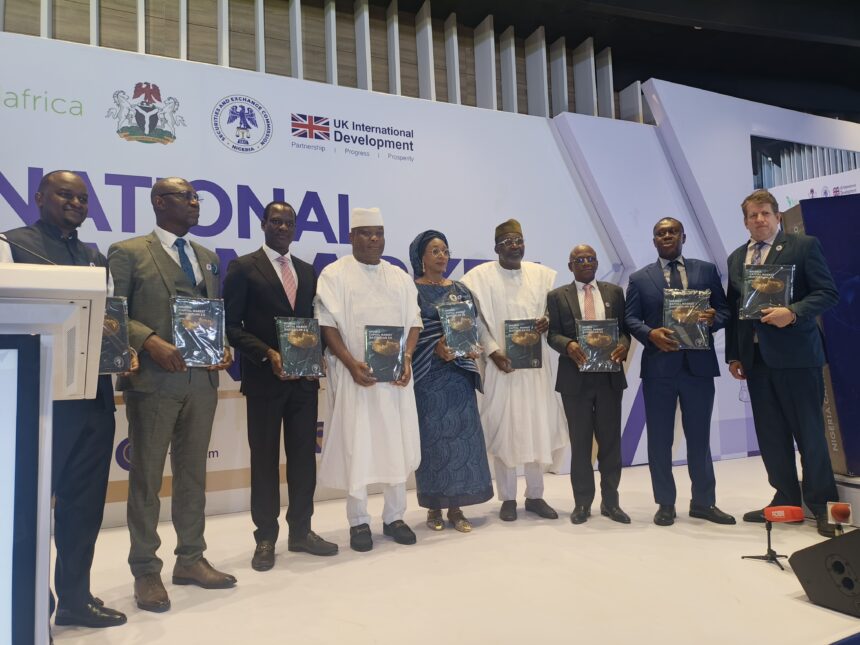
The Minister of Finance and Coordinating Minister of the Economy, Prof. Taiwo Oyedele, has unveiled the Nigeria Capital Market Master Plan 2.0, targeting the expansion of the country’s capital market to at least $1 trillion by 2036.
Oyedele announced the target on Monday in Abuja while delivering the keynote address at the 2026 National Capital Market Conference, where he also formally launched the National Savings Scheme aimed at expanding financial inclusion and encouraging Nigerians to invest through regulated financial instruments.
The minister said the new master plan, covering 2026 to 2036, would strengthen the capital market’s role in financing businesses, infrastructure development, job creation and the country’s ambition to build a $1 trillion economy by 2030.
He explained that the plan was designed to mobilise domestic and international capital, expand investment opportunities, strengthen market institutions and ensure that ordinary Nigerians benefit from economic growth.
According to him, the government is targeting an increase in the capital market’s size from approximately $250 billion to between $700 billion and $750 billion by 2036, with an ambition to push it beyond $1 trillion.
Oyedele said the ultimate objective was to build a market capable of financing the economy’s long-term development needs while providing Nigerians with safe and accessible investment opportunities.
“The capital market must be part of our national economic policy. It is central to our ambition of building a $1 trillion economy by 2030,” he said.
The minister, who said he had just returned from the International Monetary Fund and World Bank Group Annual Meetings in Bangkok, Thailand, noted that mobilising private capital for job creation featured prominently in discussions involving more than 160 countries.
He said a major lesson from the international engagements was that capital moved towards markets where investors were treated fairly, policies were predictable and evidence-based decisions guided economic management.
Oyedele commended President Bola Tinubu for the economic reforms undertaken by the administration, saying the measures had contributed to the recovery of investor confidence and improved the performance of Nigeria’s capital market.
He cited the removal of the petrol subsidy, foreign exchange reforms, tax reforms and the recapitalisation of banks as measures that had helped reposition the economy and strengthen the investment environment.
According to him, the market’s equity capitalisation has risen from about N30 trillion in mid-2023 to more than N160 trillion, while pension assets have reached approximately N27.5 trillion.
He added that collective investment schemes had expanded from N1.4 trillion in 2021 to N7.7 trillion in December 2025 and N9.3 trillion by June 2026.
The minister also highlighted renewed interest from international investors, noting that the inclusion of Nigerian government bonds in a global bond index and the country’s return to an international equity benchmark represented important developments for the market.
He said the government would continue engaging international index providers, including MSCI, to improve Nigeria’s standing in global investment markets and create opportunities for increased capital inflows.
Oyedele, however, stressed that achieving these ambitions would require sustained reforms, improved market liquidity, efficient repatriation of foreign investments and stronger protection for investors.
Five pillars of the master plan
The minister said the Capital Market Master Plan 2.0 was built around five major pillars: effective regulation, modern market infrastructure, diversified investment products, broader investor participation and stronger institutions.
Under the plan, the government intends to increase market capitalisation relative to the size of the economy, expand corporate bond issuance, deepen the pension investment market and encourage more Nigerians to participate in regulated investment schemes.
The government also plans to introduce a single investor identification number and promote investment through mobile networks and financial technology platforms to simplify access to the capital market.
Oyedele said the administration would encourage multinational companies and other eligible businesses to list on Nigerian exchanges through appropriate incentives rather than compulsory listing requirements.
He further called for the consideration of selected state-owned enterprises for listing, explaining that such a move could improve transparency, broaden public ownership and enable Nigerians to benefit from the performance of strategic national assets.
He identified the Nigerian National Petroleum Company Limited and other eligible government-linked enterprises as examples of assets whose ownership structures could be reviewed to deepen the capital market.
The minister said the plan would also promote cross-border investment and enable African businesses, including technology and artificial intelligence companies, to raise funds locally rather than relying excessively on foreign markets.
National Savings Scheme launched
Oyedele formally launched the National Savings Scheme, describing it as an important instrument for expanding financial inclusion and helping Nigerians build wealth through regulated investments.
He said the scheme would provide accessible and affordable savings and investment opportunities for people seeking to finance education, home ownership, business ventures and retirement.
According to him, the initiative is particularly important for young Nigerians who may otherwise be exposed to unregulated cryptocurrency platforms, fraudulent investment schemes and pyramid schemes.
He observed that Nigeria had only about six million retail investors despite its large population, underscoring the need to make investment opportunities more accessible to ordinary citizens.
The minister said the scheme would operate through professionally managed investment arrangements under regulatory oversight, with appropriate governance structures and mechanisms for addressing complaints.
He added that the government would work with relevant agencies to ensure transparency and compliance with applicable laws.
Oyedele said the success of the master plan would not be measured by market capitalisation alone but also by the number of new investors, the cost of transactions, the availability of capital to businesses and the level of protection provided to investors.
He urged regulators, market operators and other stakeholders to uphold high standards of accountability, transparency and professional conduct.
SEC DG seeks wider participation
Earlier, the Director-General of the Securities and Exchange Commission (SEC), Dr. Emomotimi Agama, said Nigeria’s capital market had recorded significant growth but needed broader participation and more investment products to achieve its full potential.
Agama disclosed that the market’s capitalisation had crossed N100 trillion for the first time in January 2026 before reaching approximately N163 trillion in September.
He attributed the performance to economic reforms, improvements in market infrastructure and the implementation of policies aimed at strengthening investor confidence.
The SEC chief said the Investment and Securities Act 2025 had provided a stronger legal foundation for regulating the market, addressing systemic risks, overseeing digital assets and improving enforcement.
He, however, expressed concern that the market’s expansion in value had not been matched by sufficient growth in the number of participating Nigerians and businesses.
According to him, too few Nigerians invest through collective investment schemes, while many businesses and infrastructure projects continue to depend on limited sources of financing.
Agama said the new master plan was developed through consultations with market operators, investors, issuers, regulators and government institutions.
He assured stakeholders that the commission would establish implementation mechanisms, assign responsibilities and regularly report progress towards the plan’s objectives.
The SEC director-general also described the National Savings Scheme as a means of helping young graduates, workers and other Nigerians save and invest for the future through professionally managed and regulated channels.
He thanked the United Kingdom government, the Foreign, Commonwealth and Development Office, and FSD Africa for their technical and financial support towards the development of the master plan and the savings initiative.
Shettima: Capital market must finance national development
In a goodwill message delivered on behalf of Vice-President Kashim Shettima by the Deputy Chief of Staff to the President, Senator Ibrahim Hadejia, the Federal Government said the capital market must become a major source of financing for infrastructure, businesses and economic development.
Shettima said the expansion of the market reflected the impact of the administration’s economic reforms, including changes to the foreign exchange system, the removal of the petrol subsidy and tax reforms.
He maintained that the reforms were intended to establish a more predictable economic environment in which investors could commit long-term capital.
The Vice-President said the capital market should serve as a bridge between the savings of Nigerians and the country’s investment needs, particularly in view of the infrastructure financing gap facing the federal and state governments.
He urged state governments to work with the SEC and other relevant institutions to explore responsible financing options, including infrastructure bonds, supported by credible projects, transparency and sound fiscal management.
Shettima also called on market operators and regulators to sustain the momentum by protecting investors, expanding participation and ensuring that the market’s growth translated into tangible benefits for Nigerians.
He said the master plan should help businesses raise capital locally, support agricultural development, finance infrastructure and create opportunities for enterprises across the country.
The Vice-President formally declared the Nigeria Capital Market Master Plan 2.0 launched on behalf of President Tinubu.
He urged stakeholders to ensure that the plan moved beyond policy commitments to measurable outcomes, including more jobs, greater investment participation and improved access to financing for Nigerian businesses.
The conference brought together government officials, regulators, market operators, investors and development partners to discuss strategies for positioning Nigeria’s capital market as a major driver of economic growth, financial inclusion and sustainable development.