

.
By Matthew Otabe
Stakeholders of the Progressive Middle-Belt Congress have commenced an aggressive grassroots mobilisation campaign to secure massive support for President Bola Ahmed Tinubu’s re-election in the 2027 general elections.
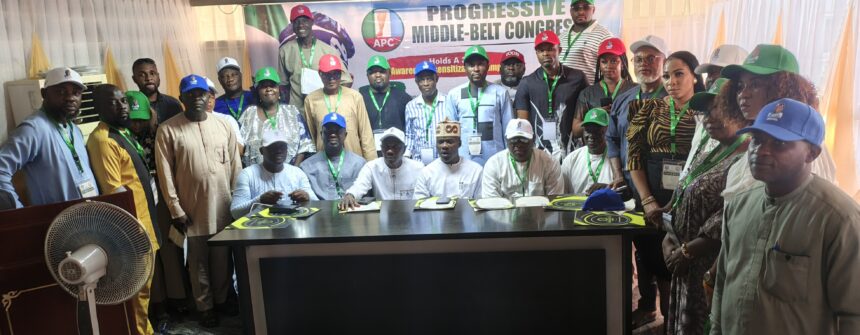
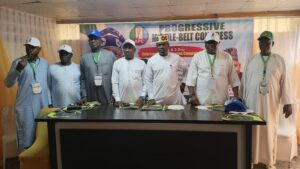
The group, which said it was targeting between 11 million and 12 million votes from the Middle Belt, launched a three-day awareness and sensitisation campaign on Wednesday at Madaki Suite, Maitama, Abuja.
The campaign, themed “Renewed Hope Agenda and Nigeria’s Developmental Benefits, Challenges, Prospects and the Hope for a New Nigeria,” brought together political leaders, government representatives, traditional and community leaders and other stakeholders from across the region.
The keynote speaker, Dr. David Alaba Makanjuola, challenged the Middle Belt to transform its long history of political struggle and representation into economic power, urging the people of the region to support continuity of the Tinubu administration in 2027.
Delivering the keynote address titled “The Middle Belt Moment: From Historical Voice to Economic Power,” Makanjuola said the region had reached a critical point where political influence must translate into tangible development for its people.
He identified the North Central Development Commission, local government financial autonomy, electricity decentralisation, livestock-sector reforms, security initiatives and increased fiscal resources as opportunities that could reshape the economic fortunes of the Middle Belt.

Makanjuola argued that continuity in government was necessary for strategic development projects and reforms to produce their full benefits.
“Governments may change. Parties may change. But strategic development must continue,” he said.
He therefore urged Middle Belt voters to consider the development implications of their political choices in 2027 and support policies they believe would advance the region’s economic interests.
According to him, the Middle Belt should move from merely demanding political representation to using its political strength to secure development, investment and employment.
“Our history brought us this far. Tarka’s generation fought for recognition. Gowon’s era created institutional space. Lar’s generation strengthened national political participation. Our generation must build economic power,” he said.
Makanjuola said the region could benefit significantly from sustained investment in agriculture, infrastructure, solid minerals, energy, security and human capital development.
He proposed a Middle Belt Economic Corridor linking federal highways to state and local roads, with the objective of connecting farmers, miners and entrepreneurs to markets.
“The objective is not merely kilometres of asphalt. The objective is lower costs, higher production, more investment and more jobs,” he said.
The keynote speaker also called for the transformation of the region’s solid minerals sector from raw extraction to processing and manufacturing, saying this would create jobs and increase the economic value of the region’s natural resources.
On agriculture, he advocated an integrated value chain covering farming, storage, processing, manufacturing, marketing and exports.
He said such an approach could enable states including Benue, Niger, Plateau, Nasarawa, Kogi and Kwara to build complementary economic strengths rather than operating as isolated economies.
Makanjuola also stressed the importance of security, noting that economic development could not thrive when farmers were unable to access their farms or investors were discouraged by insecurity.
He called for closer collaboration among federal security agencies, state governments and local communities to strengthen intelligence, prevent attacks and create a safer environment for economic activities.
The keynote speaker further urged governments at all levels to ensure accountability for public resources, saying increased revenue must translate into measurable improvements in infrastructure, jobs, agricultural productivity and security.
11m–12m Votes Target
Earlier, the Director-General of the Progressive Middle-Belt Congress, Hon. Omale Halidu, said the organisation would take its campaign to the grassroots through a door-to-door mobilisation across the region.
Halidu said the Middle Belt extended beyond the North-Central geopolitical zone and involved between 10 and 12 states, depending on the definition adopted.
He said the group was targeting between 11 million and 12 million votes for Tinubu in the 2027 presidential election.
“We are targeting 11 million voters. That is what we are trying to do in the Middle Belt. We are going across. It is not just the North-Central as it is,” Halidu said.
He said the group would also highlight appointments of people from the North-Central and Middle Belt into positions under the Tinubu administration, alongside government policies and projects, during its grassroots campaign.
Faleke’s Representative Highlights Tinubu’s Projects
Representing the Grand Commander and Convener of Tinubu Support Groups Middle Belt, Hon. James Faleke, Dr. Hassan Sadiq urged the region to support the President, citing infrastructure, education, agriculture and security initiatives of the administration.


Sadiq highlighted the Lagos-Calabar Coastal Highway and other major infrastructure projects, arguing that improved connectivity would stimulate agriculture, the blue economy, trade and employment.
He also cited the Nigerian Education Loan Fund (NELFUND), saying more than 1.8 million students had benefited from the scheme.
According to him, continued investment in education and human capital development would expand opportunities for young Nigerians and strengthen the country’s economic future.
Sadiq also pointed to investments in Nigeria’s defence and security architecture, as well as developments around the Ajaokuta steel project, as measures he said could contribute to national industrialisation and job creation.
“Nation-building is not about me today. It is about my children and grandchildren of tomorrow,” he said.
Omar: Middle Belt Will Mobilise for Tinubu
On his part, APC chieftain Hon. Umar Abutu Omar appealed to Nigerians, particularly people of the Middle Belt, to support Tinubu’s re-election bid.
Omar expressed confidence in the APC’s mobilisation efforts, saying stakeholders in the region had resolved to work extensively to secure support for the President.
“By the grace of God, with what the President has done, Nigeria will come up and master both. We have done our own work as stakeholders of APC, and the President himself, we all know what his administration is doing.
“So victory is assured, 100 per cent,” he said.
Omar said the impact of the administration’s reforms could be seen in infrastructure development across the country, particularly in the Federal Capital Territory.
“The reform is everywhere for everyone to see. You are living in the FCT here. You see the roads, infrastructure; you see everything,” he said.
He acknowledged that Nigeria had yet to reach its desired destination but argued that another term would give the administration an opportunity to consolidate its programmes.
“We are not at the promised land yet, but by the grace of God, if we give him another chance, he will take us to the promised land,” Omar added.
He described the Middle Belt as “the heart of the country” and said stakeholders were prepared to embark on extensive mobilisation.
“We are ready to go. We are good to go. These people you have seen, we will mobilise and mobilise and mobilise until we win,” he said.
Shuaibu Sets Tone for Three-Day Campaign
In his welcome address, Chairman of the Board of Trustees of the Progressive Middle-Belt Congress, Pharm. Tairu Shuaibu, said the campaign was designed to promote awareness of government policies and reforms while providing an avenue for dialogue on Nigeria’s development.
Shuaibu acknowledged the economic and social challenges facing the country but urged participants to examine both the challenges and opportunities created by ongoing government programmes.
He called for unity, peaceful participation, accountability and constructive engagement among stakeholders.
The campaign is expected to continue with grassroots sensitization and mobilisation across the Middle Belt as the group seeks to build support for Tinubu ahead of the 2027 elections.