


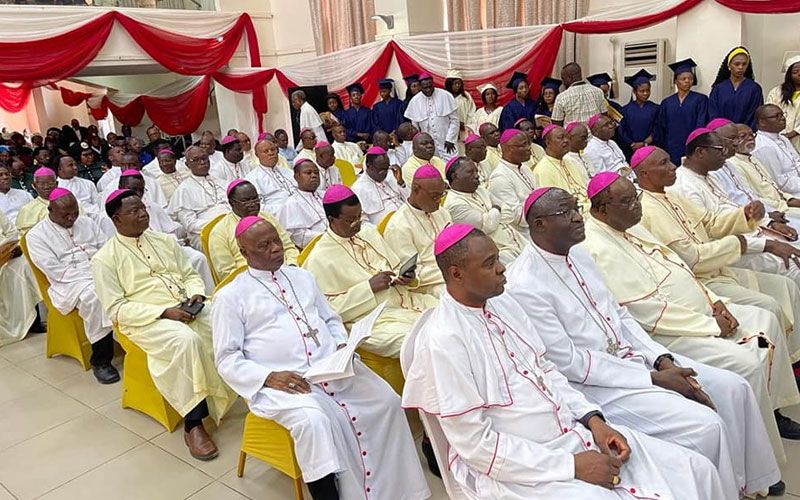
The Catholic Bishops Conference of Nigeria (CBCN) has called on the Federal and state governments to intensify efforts to tackle insecurity, poverty and infrastructural decay, warning that the challenges continue to undermine human dignity and national development.
The bishops made the call in a communiqué issued at the end of their Second Plenary Meeting for 2026, held from September 10 to 18 at the Our Lady and St. Kizito Pastoral Centre, Oke-Gada, Ede, in Osun State.
The communiqué, signed by the CBCN President, Archbishop Matthew Man-Oso Ndagoso of Kaduna, and the Secretary, Bishop Peter Olukayode Odetoyinbo of Abeokuta Diocese, was titled “Working Together for Upholding Human Dignity in Our Nation.”
The bishops said insecurity, poverty, poor infrastructure, bad governance and assaults on human dignity continued to affect Nigerians despite the country’s abundant human and natural resources.
On insecurity, the CBCN acknowledged moves by government to decentralise the police system but urged that such reforms be implemented in the interest of the common good and not for personal, ethnic, political or religious interests.
The bishops expressed concern over the continued spread of violence, kidnapping, banditry, illegal mining and the theft of the nation’s natural resources.
They specifically called on the government to take decisive measures to end banditry, recover vast portions of land occupied by criminal groups and put the recovered land to productive use.
The bishops also condemned the continued invasion of schools and places of worship, as well as the abduction and killing of students and worshippers.
They noted that the displacement of communities had taken a heavy toll on the social, economic and political lives of Nigerians, with millions of people living in internally displaced persons (IDP) camps.
The CBCN urged government at all levels to intensify efforts to enable displaced persons return safely to their ancestral homes, while ensuring that migrants and refugees are treated with respect and human dignity.
The bishops further called for stronger security forces, improved intelligence gathering and accountability for those responsible for acts of violence.
On poverty, the Catholic leaders expressed concern that economic hardship and lack of basic necessities had left many families struggling to survive despite Nigeria’s considerable national wealth.
They urged governments at all levels to create more jobs, support local businesses and implement economic policies capable of reducing the financial burden on poor and vulnerable citizens.
The bishops also called for greater private-sector participation in the economy and encouraged Nigerians to embrace honest labour, support local enterprises and shun criminality and corrupt practices.
On infrastructure, the CBCN identified bad roads, erratic electricity supply and failing public utilities as major obstacles to economic growth and everyday life.
The bishops therefore charged governments to increase transparent investment in public infrastructure, repair critical roads and ensure reliable electricity and access to clean water.
They particularly called for the expansion of railway transportation across the country to improve the socio-economic wellbeing of Nigerians.
The bishops also urged citizens to protect public infrastructure from vandalism and report corrupt practices associated with infrastructure projects.
The CBCN also expressed opposition to the Foreign Aids (Regulation, Transparency and Disclosure) Bill 2026, which has passed first and second readings in the National Assembly.
The bishops argued that although some provisions of the proposed legislation appeared aimed at ensuring transparency, they could negatively affect churches, mosques, schools and humanitarian organisations providing assistance to vulnerable and conflict-affected communities.
They particularly raised concern over provisions that could allow authorities to deny or refuse renewal of registration where an organisation’s activities are considered not to be in the “national interest.”
According to the bishops, such provisions could give government officials broad discretionary powers, create unnecessary bureaucracy and place excessive restrictions on civic organisations.
They maintained that non-profit organisations, incorporated trustees, churches, mosques and other religious and humanitarian bodies were already regulated under existing laws, including the Companies and Allied Matters Act.
The CBCN consequently urged the National Assembly and Federal Government not to proceed with the process of enacting the bill, citing concerns over freedom of association, religion, thought and conscience.
Bishops Urge Ethical Use of Technology
On technology and Artificial Intelligence, the bishops said technology should be deployed responsibly and ethically, particularly as the country approaches the 2027 general elections.
They described technology as a profoundly human reality, while stressing the primacy of the spiritual over the material.
The bishops urged politicians and other stakeholders to exercise responsibility in deploying technology and AI, while encouraging their use for evangelisation and for transforming data into knowledge and useful insights.
Call for Credible 2027 Elections
Ahead of the 2027 general elections, the CBCN called on all stakeholders to work towards free, fair and credible elections.
The bishops encouraged eligible citizens to participate actively in the electoral process and vote in accordance with their consciences.
They also announced plans for dioceses and parishes across the country to undertake civic education and mobilisation, as well as end-of-month fasting and Rosary processions from October to December 2026 in preparation for the elections.
The bishops declared December 8, 2026, as a special national day of prayer and fasting for the success of the elections.
The CBCN also called for renewed politics centred on moral principles, protection of human life and dignity, and the pursuit of the common good.
The bishops said Nigeria’s challenges of national integration were significant but insisted that hope remained, urging citizens to contribute to positive change at home, in their workplaces and communities.