


By Matthew Otabe
The Central Bank of Nigeria (CBN) has warned banks and other financial institutions to strengthen their cybersecurity frameworks, information-sharing mechanisms and business continuity systems to safeguard Nigeria’s financial system against growing cyber and systemic risks driven by artificial intelligence (AI).
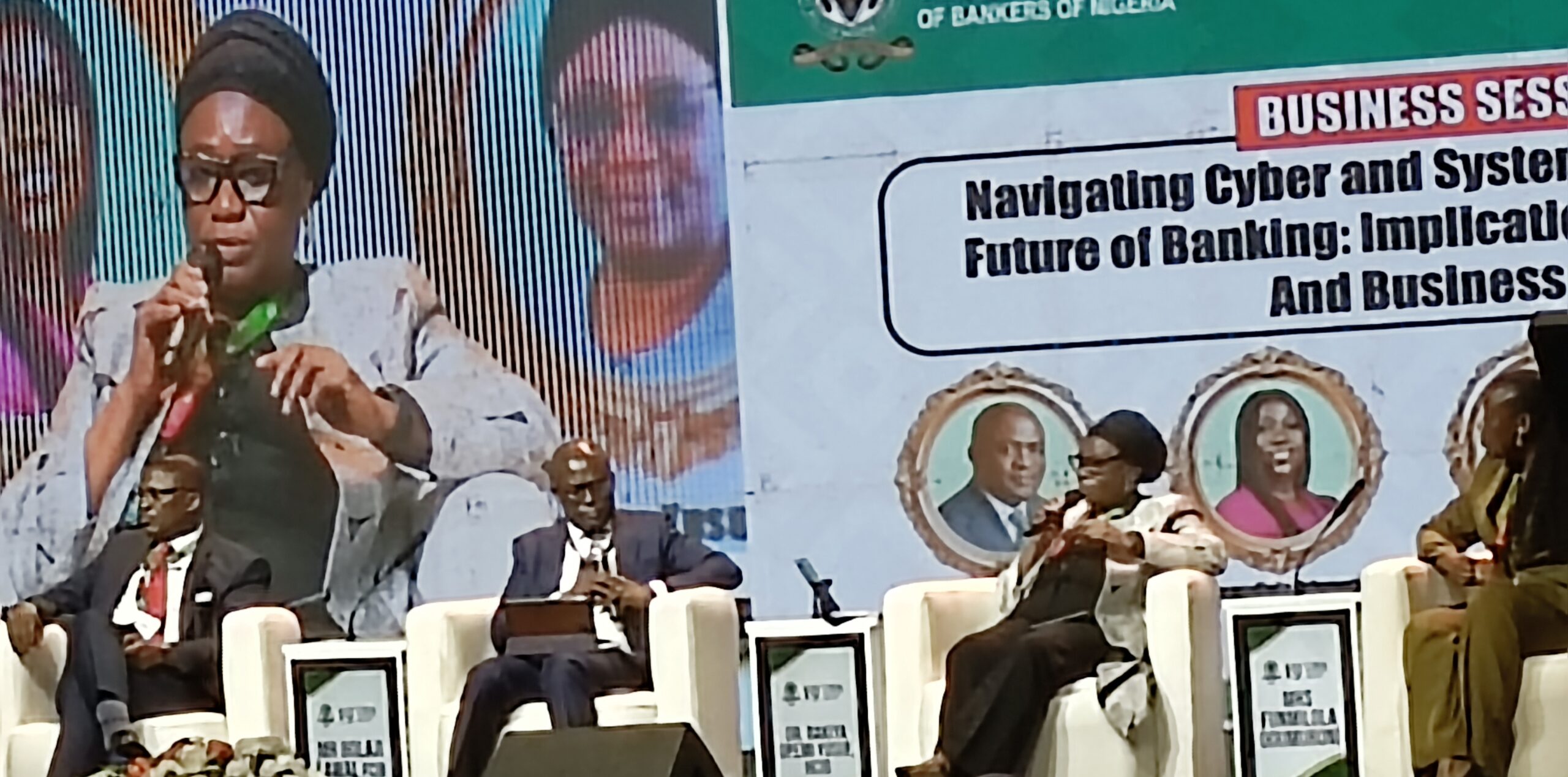
The Director, Payments System Supervision Department of the CBN and Chairperson of the Nigeria Electronic Fraud Forum, Dr. Mrs. Rakiya Opemi Yusuf, gave the warning on Wednesday in Abuja while speaking during a panel session on “Navigating Cyber and Systemic Risks in the AI-Driven Future of Banking: Implications for Financial Stability and Business Resilience,” organised by the Chartered Institute of Bankers of Nigeria (CIBN).
Yusuf said financial institutions must not only focus on protecting their individual organisations but also consider how vulnerabilities in their interconnected ecosystem could trigger wider disruptions across the financial system.


She stressed that resilience was about the ability of an institution to continue delivering financial services during disruptions, stress or cyber incidents, as well as how quickly it could recover from such events.
According to her, the CBN continues to strengthen policies, regulations, frameworks and supervisory measures, including considerations at the product-approval stage, to ensure that vulnerabilities capable of threatening financial stability are identified and addressed before they crystallise.
She said the increasing interconnectedness among banks, fintechs, payment service providers, cloud-service providers and other third-party technology providers required financial institutions to adopt a broader approach to risk management.
Yusuf urged institutions to ensure that their cybersecurity and risk-management responsibilities extend beyond their own internal systems to third-party providers and other entities within their operational ecosystem.
She also called for timely reporting of cyber incidents and vulnerabilities to enable regulators to intervene before such incidents develop into systemic threats.
The CBN director emphasised the importance of information and intelligence sharing among financial institutions, noting that stronger collaboration would enable the industry to identify emerging threats and respond to them more effectively.


She further advocated stronger Security Operations Centres (SOCs), including mechanisms capable of monitoring threats across the financial ecosystem in real time.
Yusuf warned that weaknesses in one institution or service provider could potentially spread across interconnected institutions, creating a “one-fire” effect capable of disrupting the wider financial system.
She therefore urged financial institutions to conduct regular assessments of their dependencies, third-party relationships and technology providers to determine how failures in one part of the ecosystem could affect their own operations.
The CBN official also stressed the need for institutions to pay greater attention to third-party risk management, particularly as banks increasingly rely on external technology, cloud and digital service providers.
She said institutions should ask critical questions about the resilience of their third-party partners, including how quickly they could recover if a service provider suffered a cyberattack or major operational disruption.
On AI, Yusuf said financial institutions must approach the technology with both innovation and accountability in mind, stressing that automation should not eliminate human responsibility.
She described the concept as “automating accountability,” noting that although AI could perform increasingly sophisticated tasks, human beings would continue to bear responsibility for decisions and processes involving financial services.
She urged banks to be intentional about understanding their cyber-risk exposure, particularly because financial institutions operate within a highly interconnected system where the vulnerability of one entity could have consequences for others.
Yusuf also challenged financial institutions to pay greater attention to data governance and digital sovereignty, asking them to examine where their critical data is stored, who has access to it, what insights can be derived from it and how it supports decision-making.
She warned that institutions could expose themselves to significant risks if critical data or technological capabilities were placed beyond their effective control.
The CBN director maintained that resilience in the AI-driven financial environment would require institutions to combine technological innovation with strong governance, human oversight, cybersecurity, data protection and effective risk-management frameworks.
She further called on stakeholders in the financial ecosystem to work collectively to strengthen the resilience of Nigeria’s payment and banking systems, stressing that protecting the system was a shared responsibility.
According to her, the objective should be to build a financial ecosystem capable of absorbing shocks, containing cyber incidents and recovering quickly without allowing the failure of one institution or service provider to destabilise the entire system.