Ooni, Obi of Onitsha hail Akwa Ibom Governor as Daily Times names him South-South’s Most Outstanding Governor
By Titus Atondu
In a country where political leadership is often measured by promises, projects and the ability to connect government with the people, recognition from respected traditional institutions carries a significance of its own.
For Akwa Ibom State Governor, Pastor Umo Eno, that recognition came in Abuja when two of Nigeria’s prominent traditional rulers—the Ooni of Ife, His Imperial Majesty Oba Adeyeye Enitan Ogunwusi, and the Obi of Onitsha, His Majesty Igwe Nnaemeka Achebe, CFR—publicly commended his leadership.
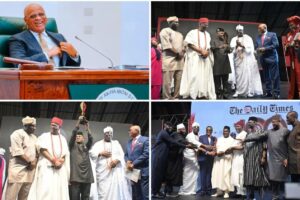
The occasion was the Daily Times Centenary Heroes Awards held at the ThisDay Dome, Abuja, where Eno was honoured as “Most Outstanding Governor in Nigeria – South-South.”
The award did more than add another honour to the governor’s growing list of recognitions. It provided a national platform for an assessment of his administration and the development agenda he has pursued in Akwa Ibom since assuming office.
A Royal Commendation
The commendation from the Obi of Onitsha was particularly significant because it was anchored on personal observation.
Igwe Achebe, who presented the award, said his visits to Akwa Ibom had left him impressed by the governor’s efforts, particularly his focus on the welfare of the people.
“I have been to Akwa Ibom State on several occasions, and I am very impressed with the work he is doing, particularly his commitment to the welfare of the people. We encourage him to keep the flag flying,” he said.

The statement placed the award within a broader conversation about what citizens expect from political leadership: not merely infrastructure, but governance that responds to human needs.
For Eno, the endorsement suggested that the impact of his administration is attracting attention beyond the political structures of the state.
The Ooni of Ife, Oba Ogunwusi, also offered his own assessment, describing the governor as a “good man” and a “performer.”
“He is a good man. He is doing well. Please extend my greetings to him,” the Ooni said.
Coming from two influential traditional rulers, the words provided a powerful backdrop to an award that already placed Eno among governors being recognised for their performance at the national level.
The Politics of Performance
Governance is ultimately judged by its impact on the people.
Across Nigeria, state governments operate within different economic realities, political environments and development challenges. For governors, the task is to translate public resources and policy into tangible improvements in the lives of citizens.
It is against this backdrop that the Daily Times recognition of Eno becomes significant.
The organisers described him as the Most Outstanding Governor in the South-South, recognising his performance since assuming office.
Although awards alone cannot provide a complete measure of governance, they often offer an opportunity to examine the priorities and public perception surrounding an administration.
In Eno’s case, the recognition comes alongside commendations for projects and initiatives undertaken by his administration and his stated emphasis on the welfare of Akwa Ibom people.
The royal endorsements at the Abuja ceremony consequently shifted attention from the award itself to the leadership philosophy behind it.
From Akwa Ibom to the National Stage
Governor Eno was not physically present to receive the honour. He was represented by the Commissioner for Information, Hon. Aniekan Umanah, and the Chief Press Secretary, Mr. Ekerete Udoh.
Yet, the governor’s absence did little to diminish the attention surrounding the recognition.
The presence of prominent political leaders, traditional rulers, business executives and other personalities transformed the event into more than a celebration of a newspaper’s history. It became a gathering where contributions to Nigeria’s development were publicly acknowledged.
The event was chaired by President Bola Ahmed Tinubu, represented by the Secretary to the Government of the Federation, Senator George Akume.
Also in attendance were Niger State Governor Umaru Bago, Nasarawa State Governor Abdullahi Sule and Zamfara State Governor Dauda Lawal.
The APC National Chairman, Prof. Nentawe Yilwatda; Minister of Aviation and Aerospace Development, Festus Keyamo, SAN; and Deputy Speaker of the House of Representatives, Rt. Hon. Benjamin Kalu, were among other prominent personalities at the ceremony.
A Centenary Celebration with a Wider Message
The Daily Times Centenary Heroes Awards was organised to mark 100 years of the newspaper and honour individuals and institutions considered to have made significant contributions to public service, business and community development.
The centenary itself provided a fitting context for the celebration.
For a newspaper that has witnessed Nigeria’s journey through colonial rule, independence, military administrations, democratic transitions and the complexities of modern governance, celebrating individuals contributing to national development offered an opportunity to reflect on the country’s evolving leadership landscape.
The keynote address by former President of the African Development Bank, Prof. Akinwumi Adesina, reinforced that broader theme.
Adesina commended the Daily Times for surviving the test of time and for playing a role in Nigeria’s development.
Against this backdrop, Eno’s recognition placed his administration within a larger national conversation about leadership, development and public service.
The Road Ahead
For Governor Eno, however, an award is unlikely to be the final measure of his administration.
The greater test lies in whether the policies and projects attracting recognition can produce lasting improvements in the lives of Akwa Ibom residents.
The commendations from the Ooni of Ife and the Obi of Onitsha may therefore be viewed not simply as applause, but as an additional expectation for the governor to sustain the momentum.
The Obi’s call to “keep the flag flying” captures the challenge that accompanies recognition: maintaining performance after the spotlight has moved elsewhere.
As the Daily Times celebrates a century of journalism, the recognition of Umo Eno offers another story about contemporary Nigeria—a story in which leadership is increasingly being assessed through the prism of performance, people-centred governance and measurable development.
For Akwa Ibom, the award adds another chapter to the story of a state seeking to position itself through development and effective administration.
For Eno, it represents both an honour and a responsibility: the recognition of what has been achieved, and a reminder of what remains to be done.