Politics
Tarka Council Boss Yenge Highlights 24-Point Scorecard, Says Governance Must Be Felt Across Wards

By Titus Atondu, Makurdi
The Chairman of Tarka Local Government Area of Benue State, Hon. Raphael Yenge, has highlighted a series of interventions in electricity, water, roads, healthcare, education, youth empowerment, security and transportation as evidence of his administration’s commitment to people-centred governance.
Yenge, who assumed office after his election on October 5, 2024, made this known when he presented the scorecard of his administration to journalists during the ongoing facility assessment tour of the 23 local government areas of Benue State organised by the Nigeria Union of Journalists (NUJ), Benue State Council.


The assessment tour, led by the NUJ Chairman, Comrade Bemdoo Ugber, provided journalists with the opportunity to inspect projects executed by the council and assess their impact on residents.
At the council secretariat in Wannune, Yenge presented a 24-point scorecard of his administration, saying his primary objective had been to reconnect grassroots governance with the everyday needs of the people.
He maintained that development should not be measured merely by statistics or official documents, but by tangible projects capable of improving the quality of life and dignity of residents.

One of the major areas highlighted by the chairman was rural electrification.
According to him, the council installed a 500KVA transformer at Zongo and repaired other transformers, restoring electricity to communities that had reportedly remained without power for several years.
He added that electrification projects were ongoing in Pipeline, Aso and Cherrywood, while the installation of another transformer at Tse Agbuku in Mbaikyaa Council Ward was nearing completion.
The council headquarters in Wannune has also witnessed rehabilitation and environmental improvement, with the chairman’s office and quarters renovated and solar-powered streetlights installed along the Secretariat road, within the council premises and at the Chairman’s Quarters.


Yenge said the lighting projects were designed not only to improve the appearance of the council environment but also to enhance security and make the facilities more functional at night.
Other public facilities, including blocks at the Tarka Senior Staff Quarters in Wannune, were rehabilitated, while VIP toilets at Wannune Market Square were renovated to improve sanitation and public hygiene.
In transportation, the council focused on rehabilitating its existing assets, with three council buses, an ambulance, legislative bus and sports bus repaired.
Two tractors were also repaired and deployed to support agricultural activities in the local government.
Water supply, another critical area of grassroots development, also featured prominently in the council’s interventions.
Yenge disclosed that the council drilled and installed a solar-powered borehole at Nyambee and two electric motorised boreholes at Aboho.
He said 22 boreholes across various wards were also rehabilitated, thereby improving access to potable water for residents in rural communities.
On road infrastructure, the chairman cited the construction of the Ukyough Bridge under the RAAMP-BN Programme and the grading of the Nyambe-Ukyough rural road as major interventions.
According to him, the projects have improved connectivity between Tarka and neighbouring Guma Local Government Area, while facilitating the movement of farm produce and access to markets for rural communities.
The health sector has equally received attention, with the council resuscitating and upgrading the Ijorimenger Special Primary Health Care Centre, which has now been institutionalised as a Benue State University Teaching Hospital (BSUTH) Annex.
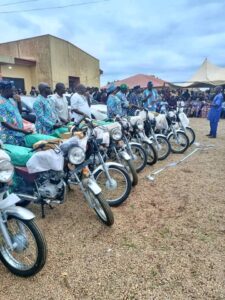
To improve mobility and support the discharge of official responsibilities, the council donated electric motorcycles to 10 councillors.
Yenge also disclosed that five vehicles and 25 motorcycles were purchased for key officers of the council and critical stakeholders to facilitate their daily movement and official duties.
Beyond physical infrastructure, the chairman identified human capital development as another major priority of his administration.
He said more than 400 youths had been trained through the council’s skills acquisition programme in various trades and vocations, with the objective of equipping them with practical skills and improving their economic prospects.
The council also awarded scholarships to 120 students across primary, secondary and tertiary institutions.
Similarly, 400 Tarka indigenes benefited from free registration for the 2026 Joint Admissions and Matriculation Board (JAMB) examination as part of efforts to expand access to higher education.
In the education sector, the council distributed 10,000 exercise books to pupils and students across schools in the local government, while the 2025 Children’s Day was marked with pupils and students from various communities in Tarka.
The administration also upgraded its Computer Unit as part of efforts to strengthen digital record-keeping and improve administrative efficiency.
In sports development, the council constructed a badminton pitch at the Chairman’s Quarters to promote recreation and sporting activities.
On security, Yenge said the administration had maintained close collaboration with security agencies, traditional rulers and community stakeholders.
He described the council’s security record as a major achievement, claiming that no Tarka indigene had lost his or her life to a herdsmen-related attack since he assumed office.
“We have touched power, water, roads, health, education and youth development. Our goal is to ensure that governance is felt in every ward and village,” Yenge said.
The chairman also disclosed that his administration provided and donated the Tarka APC Secretariat as part of efforts to strengthen the party’s structure in the local government.
According to him, the various interventions were implemented in alignment with Governor Hyacinth Alia’s broader agenda of infrastructure renewal and human capital development, while ensuring prudent management of public resources.
Speaking during the assessment, NUJ Chairman, Comrade Bemdoo Ugber, commended the Tarka council administration for opening its facilities and records to journalists.
Ugber described transparency and openness to scrutiny as important elements of accountable governance, stressing that the assessment tour was intended to provide an independent opportunity to evaluate projects and their impact on the people.
The Tarka experience, therefore, reflects an approach to local government administration centred on infrastructure development, human capital investment, social services and security.
However, the ultimate test of the Yenge administration’s performance, observers say, will be the sustainability of the projects and the extent to which they translate into lasting improvements in the daily lives of residents.
For communities that rely heavily on grassroots institutions for basic services, the challenge remains to sustain the momentum and ensure that development is not only visible but also responsible, inclusive and genuinely people-oriented.