Energy
NIHTE, IRF Move to Deploy AI for Smarter, Safer Road Management in Nigeria

The Nigerian Institution of Highway and Transportation Engineers (NIHTE), in collaboration with the International Road Federation (IRF), has called for the adoption of Artificial Intelligence (AI) and other emerging technologies to transform road management, improve safety and strengthen the resilience of Nigeria’s transportation infrastructure.
The call was made on Monday at a training programme on “AI Applications for Road Management” organised by NIHTE and IRF in Abuja, where engineers, government officials, regulators, development agencies and industry stakeholders examined ways of deploying AI across the life cycle of road infrastructure.
Declaring the training open, the Acting National Chairman of NIHTE, Engr. Dr. Bola Mudasiru, described the workshop as timely and strategic, saying it would provide an opportunity for Nigerian engineers to acquire advanced knowledge and explore international best practices in the application of AI to road management.
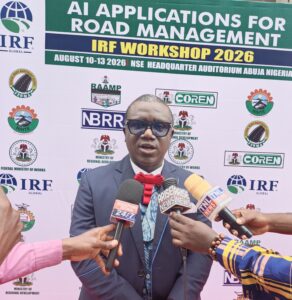

Mudasiru said Nigeria’s road network, spanning more than 200,000 kilometres, remains a backbone of the nation’s economy but faces challenges including maintenance backlogs, deteriorating infrastructure, traffic congestion, road safety concerns, flooding and erosion.
According to him, conventional approaches to road management are no longer sufficient to address the growing complexity of the challenges confronting the sector.
He said AI could provide practical solutions in predictive maintenance, traffic-flow optimisation, asset management, road safety and climate resilience.
“AI offers practical solutions across the entire life cycle of road infrastructure — predictive maintenance, traffic flow optimisation, asset management, safety enhancement and climate resilience,” he said.
He added that AI models could help engineers simulate flood risks and erosion patterns, thereby providing useful information for adaptive road designs and infrastructure planning.
Mudasiru, however, cautioned that the deployment of AI must be guided by professional ethics, transparency, inclusivity, data privacy and sustainability.
He said the partnership between NIHTE and IRF had provided a platform for bridging the gap between local expertise and global best practices, noting that the organisations had consistently used their annual training programmes to promote knowledge transfer, capacity building and professional development.
He urged participants to actively engage in the technical sessions, share experiences and explore ways of localising AI applications to address Nigeria’s peculiar road infrastructure challenges.
“This programme is not merely about technology. It is about legacy. It is about ensuring that the roads we design, build and manage today serve generations yet unborn,” he said.
Speaking on the IRF’s global perspective, Martins Van Gils, a representative of the International Road Federation, said the organisation was committed to helping countries understand practical applications of AI in road management.
Van Gils said the IRF brings together professionals from academia, government agencies and the contracting industry to develop solutions to common infrastructure challenges.
He said the organisation’s experience across more than 130 countries provided a broad platform for sharing knowledge, case studies and emerging practices.
According to him, AI presents a new field requiring close collaboration among stakeholders to identify appropriate use cases and ensure that the technology is deployed effectively.
He also stressed the importance of maintaining human intelligence alongside artificial intelligence.

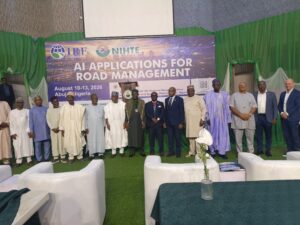
0-0x0-0-0#
“We don’t only need to look at artificial intelligence; there is still a basis for human intelligence as well,” he said.
The Immediate Past National Chairman of NIHTE, Engr. Hassan Saidu, said the institution’s relationship with the IRF dates back to the period when NIHTE became a division of the Nigerian Society of Engineers (NSE).
He said the partnership was established to expose Nigerian engineers to international expertise and reduce the cost of sending professionals abroad for specialised training.
Saidu said NIHTE had, over the past decade, organised annual international training workshops covering areas such as safe road design, performance-based contracts and road asset management.
He said the institution would continue to sustain the partnership in order to strengthen the capacity of Nigerian highway and transportation engineers.
The Chairman of the Occasion and President of the Nigerian Society of Engineers, Engr. Ali Alimasuya Rabiu, described AI as a transformative force reshaping infrastructure planning, predictive maintenance, traffic management, pavement performance monitoring, asset management and transport safety globally.
Rabiu said the training presented an opportunity for participants to acquire cutting-edge knowledge, practical skills and international best practices that could help modernise Nigeria’s road infrastructure.
He urged government at all levels to increase the participation of indigenous engineers and engineering firms in the planning, design, construction, rehabilitation and maintenance of roads.
According to him, greater involvement of Nigerian professionals would strengthen local capacity, create jobs, encourage technology transfer and help retain expertise within the country.
Rabiu also commended the Minister of State for Works for sponsoring about 25 ministry officials to attend an engineering conference in Glasgow, United Kingdom.
In his remarks, the Minister of Regional Development, Engr. Abubakar Momoh, said roads play a critical role in connecting communities to markets, schools, healthcare facilities and agricultural value chains, while promoting investment and national integration.
The Minister emphasized that the Federal Government is investing in roads, bridges and other critical infrastructure across the country, stressing that existing assets must be properly monitored and maintained to maximise their useful life.

He said AI could assist engineers and road managers in identifying defects, predicting deterioration, monitoring infrastructure performance, prioritising maintenance interventions and deploying limited resources more efficiently.
The minister said the adoption of emerging technologies was consistent with the Federal Government’s efforts to modernise public infrastructure and use innovation to improve governance, economic competitiveness and sustainable development.
He, however, emphasised that technology could only be effective when deployed by competent professionals.
“This is why this kind of workshop is very important, so that practitioners can continually update themselves on modern realities, because the world is rapidly growing in terms of innovation and technology,” he said.
Momoh urged participants to see the training as an opportunity to develop solutions that could be adopted within Nigeria’s road infrastructure ecosystem.
He also called on NIHTE to extend the knowledge gained from the workshop to other government agencies and regional development commissions through smaller capacity-building programmes.
The National Coordinator of the Rural Access and Agricultural Marketing Project (RAAMP), Engr. Aminu Bodinga Mohammed, who was represented by Engr. Bukar Gana, said the programme was particularly relevant to the agency because of its focus on road asset management.
He disclosed that RAAMP, in collaboration with the World Bank and French Development Agency, had developed the Nigeria Rural Infrastructure Management System, a digital platform containing data on more than 100,000 kilometres of rural roads.
He said the system captures information on road conditions, pavement types, roughness indices, bridges and the socio-economic characteristics of communities along the road network.
According to him, the platform also supports planning and prioritisation of road maintenance based on available budgets.
Gana said RAAMP was interested in exploring how AI could further enhance the digital road asset management system and improve maintenance planning.
The President of the Council for the Regulation of Engineering in Nigeria (COREN), Engr. Prof. Sadiq Zubair Abubakar, said Nigerian engineers must become AI-competent to remain relevant in an increasingly technology-driven infrastructure sector.
He said AI could enable the profession to move from remedial interventions to proactive and predictive maintenance.
Abubakar, however, warned engineers against blindly relying on AI, stressing that professional responsibility, accountability, ethics, public interest and cost-effectiveness must remain central to engineering practice.
He called for more specialised capacity-building programmes, saying continuous professional development was essential to closing knowledge gaps within the profession.
In a vote of thanks, the Chairman of the Planning Committee, Engr. Isa Emoabino, said the programme went beyond training engineers, describing it as an avenue to widen the knowledge gap among Nigerian professionals through collaboration and knowledge sharing.
He urged participants to actively ask questions, seek clarification and ensure that the knowledge acquired was translated into practical improvements, particularly in field operations and infrastructure development.