By Matthew Otabe
By all accounts, the Nigeria Union of Agriculture and Allied Employees (NUAAE) stood on the brink. Years of bitter leadership disputes had fractured one of Nigeria’s oldest industrial unions into three rival factions, each claiming legitimacy, each operating separate executives, and each dragging the organisation deeper into paralysis.
For many observers, reconciliation appeared impossible.
But for Comrade Abdullahi Dandabo, former National President of NUAAE, former National Auditor of the Nigeria Labour Congress (NLC), and one of the union’s longest-serving leaders, allowing the organisation to collapse was never an option.
“If I have spent nearly 30 years building this union,” he reflected during an interview, “I cannot sit back and watch it go into destruction.”
His words capture not only a personal commitment but also the remarkable journey of a labour leader whose career has been intertwined with the growth, struggles and eventual reunification of one of Nigeria’s most strategic trade unions.
A Journey That Began in 1992
Dandabo’s union story began in 1992 while working with the Bakolori Irrigation Project under the Federal Ministry of Agriculture in Sokoto State.
The project, which employed both Nigerian and foreign workers, exposed him to organised labour at a time when employees sought better welfare and protection of their rights.
When the Agriculture and Allied Workers Union was introduced to the project, Dandabo immediately embraced the movement.
“I realised that workers needed a collective voice to protect their rights and privileges,” he recalled.
His colleagues quickly recognised his leadership qualities, electing him as one of the branch officials. That decision marked the beginning of a labour career spanning more than three decades.
Learning the History While Making It
Rather than merely participating in union activities, Dandabo immersed himself in studying the evolution of organised labour in Nigeria’s agricultural sector.
He traced the union’s roots to the restructuring of Nigeria’s trade unions in 1978, when numerous smaller unions were consolidated into stronger industrial unions.
He spoke with admiration of early pioneers such as Kola Balogun, one of the union’s first General Secretaries, and several presidents who laid the foundation for what later became NUAAE.
By 1993, Dandabo had risen to the position of National Auditor during the union’s National Delegates Conference in Ilorin, Kwara State.
A decade later, at the 2003 National Conference in Minna, Niger State, delegates elected him National President.
Building Unity Before Crisis
During his presidency, Dandabo championed one of the union’s most significant structural reforms.
Recognising that workers performing similar responsibilities were scattered across different organisations, he supported the merger of unions within the agricultural sector to create a stronger and more united labour movement.
The Federal Ministry of Labour facilitated the discussions, while stakeholders agreed that unity would strengthen workers’ bargaining power.
Following the merger conference in 2008, Dandabo was again elected president, leading the enlarged organisation until 2012.
When the Union Nearly Fell Apart
Years after leaving office, NUAAE descended into its deepest crisis.
A disputed election in April 2024 produced three competing leadership groups, each claiming legitimacy. Every faction appointed its own president, general secretary and executive members.
The conflict crippled the union
The Nigeria Labour Congress refused to recognise any faction, while the Trade Union Congress and other labour bodies distanced themselves from the dispute.
Even the Federal Ministry of Labour struggled to broker peace.
“It became impossible for the union to function as one organisation,” Dandabo said.
The crisis threatened not only the union’s credibility but also its ability to represent thousands of agricultural workers nationwide.
The Call to Return
With reconciliation efforts failing, respected labour leaders appealed to Dandabo to intervene. Drawing on decades of experience, he accepted the challenge—not to reclaim power, but to restore peace.
His strategy differed from previous attempts.
Instead of determining who was right or wrong, he listened patiently to every faction.
“We allowed everyone to explain their position,” he said. “Then we kept meeting until trust gradually returned.”
Those meetings often stretched late into the night.
There were disagreements, accusations and legal arguments over constitutions, elections and leadership mandates.
Yet Dandabo insisted that lasting peace could only emerge through dialogue.
Turning Rivals into Partners
The breakthrough came when he persuaded two of the rival factions to merge.
Rather than competing against each other, they agreed to form a common front.
The remaining faction soon joined the discussions.
To ensure transparency, representatives of the NLC, the Federal Ministry of Labour, the Federal Ministry of Agriculture and other labour stakeholders participated in the mediation process.
A reconciliation committee was established to oversee negotiations.
One of the most difficult issues involved sharing leadership positions among the factions.
Every group wanted the presidency.
Dandabo urged them to abandon winner-takes-all politics.
“We are all equal,” he reminded them. “The important thing is saving the union.”
Eventually, the parties agreed on a power-sharing arrangement that distributed key offices fairly across the former factions.
Expanding Leadership for Peace
To accommodate every interest, the committee proposed expanding the National Executive Council from 19 members to 33.
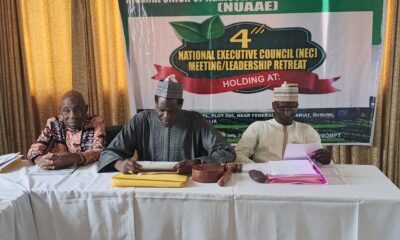
The recommendation formed part of a Memorandum of Understanding signed by all parties after months of negotiations.
The agreement also created a monitoring mechanism involving the NLC, the Federal Ministry of Labour and representatives of the reconciled factions to ensure faithful implementation.
Dandabo believes this monitoring structure prevented the peace deal from collapsing.
“Implementation is always the hardest stage,” he explained.
Sleepless Nights for a Greater Cause
Behind the reconciliation were countless hours of sacrifice.
Dandabo recalled receiving telephone calls deep into the night as fresh disagreements emerged.
His team reviewed hundreds of petitions, legal documents, reports and constitutional provisions. He estimates that more than 900 pages of documents passed through his hands during the peace process.
“There were many sleepless nights,” he said.
“But saving the union was worth every sacrifice.”
More Than Buildings
Reflecting on his years in office, Dandabo believes leadership is measured not only by infrastructure but by institutional stability.
He recalled helping the union relocate its headquarters from Lagos to Abuja during Nigeria’s broader administrative transition.
Despite severe financial constraints, his administration secured office accommodation, negotiated support from sister unions and eventually acquired a permanent national secretariat.
Those achievements, he said, strengthened the union’s administrative capacity.
Yet he considers restoring unity among members to be his greatest legacy.
Agriculture Deserves One Voice
For Dandabo, the struggle extends beyond union politics.
He argues that agriculture remains Nigeria’s oldest and most important profession, employing millions and sustaining national food security.
Such a sector, he insists, deserves a strong, united labour organisation capable of defending workers’ welfare.
“We cannot allow agriculture workers to remain divided,” he said. “Today, there is only one union. That is the greatest achievement.”
His story serves as a reminder that while institutions may be shaken by conflict, determined leadership, patient dialogue and a willingness to compromise can restore even the deepest fractures.
For Comrade Abdullahi Dandabo, the real victory was never occupying an office. It was ensuring that the union he helped build would survive for future generations of Nigeria’s agricultural workers.