

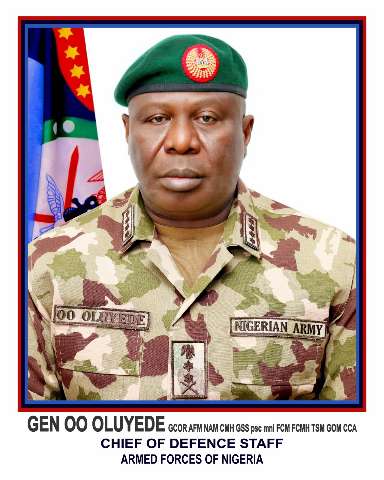
For Nigeria’s Armed Forces, the battle against insecurity is no longer confined to a single battlefield. From the insurgency-ravaged forests of the North East to the oil-rich creeks of the Niger Delta and the volatile communities of the North Central, troops are simultaneously confronting terrorists, kidnappers, separatists, armed militias and crude oil thieves.
The latest operational briefing by the Defence Headquarters covering July 17 to 23, 2026, paints a picture of a military fighting multiple wars at once while attempting to secure highways, rail lines and communities across the federation.
Although security challenges remain widespread, the week’s operations demonstrated how intelligence-driven missions, air strikes and coordinated ground offensives continue to weaken criminal networks and rescue innocent Nigerians from captivity.
Decapitating Terrorist Leadership
Perhaps the most significant success came in the North East where troops of Operation HADIN KAI dealt a strategic blow to Boko Haram and ISWAP.
Among those neutralised was Abu Salim Al-Barnawi, described by the military as a senior terrorist commander and propaganda chief.
Unlike ordinary fighters, propaganda commanders play a vital role in terrorist organisations. They recruit new members, spread extremist ideology, coordinate information warfare and sustain the morale of insurgents.
His elimination therefore represents more than the loss of another battlefield commander—it disrupts the insurgents’ communication structure and weakens their ability to attract recruits.
Air power also proved decisive during the week
The Nigerian Army Aviation struck terrorist positions in Yaganari, Bama Local Government Area of Borno State, killing scores of insurgents before they could regroup.
Meanwhile, troops prevented what could have become another tragic attack by foiling an attempted infiltration of the University of Maiduguri, killing two terrorists during the encounter.
The operation underscored the military’s increasing focus on protecting schools and other vulnerable public institutions.
Every Rescue Means a Family Reunited
Behind every operational statistic lies a human story.
One of the week’s most emotional successes occurred around Amuda Bridge in Gwoza Local Government Area of Borno State, where troops carried out three rescue operations that freed a mother, her two children and two young girls.
Military authorities disclosed that one of the rescued groups had been held captive since August 2025.
For nearly a year, the victims had remained in terrorist captivity before regaining their freedom.Such rescues illustrate another important dimension of Nigeria’s counter-insurgency campaign—not merely eliminating terrorists but restoring shattered families and communities.
The Silent Network Behind Terrorism
Modern terrorist organisations survive not only because of armed fighters but also because of extensive civilian support networks.
Across the North East, troops arrested numerous logistics suppliers, suspected spies, collaborators and couriers accused of supplying food, fuel, intelligence and transportation to insurgents.
Among those arrested were a suspected Sudanese foreign fighter and an illegal immigrant from Ghana, highlighting the transnational dimension of terrorism in the Lake Chad region.
The arrests demonstrate that counter-terrorism is increasingly targeting the financial and logistical systems that sustain armed groups rather than focusing solely on gun battles.
Kidnapping Still Demands National Attention
While terrorism remains concentrated in parts of the North East, kidnapping continues to threaten virtually every region of the country.
Military operations during the week reflected this reality.
In Zamfara State, troops responded swiftly after terrorists barricaded the Gummi-Sokoto Road and abducted passengers from a commercial vehicle.
The intervention forced the attackers to flee and led to the rescue of 11 victims.
In Kwara State, troops under Operation SAVANNAH SHIELD neutralised four kidnappers, arrested two others and rescued another victim during a joint operation with local vigilantes and forest guards.
Across Benue, Nasarawa, Taraba and Kogi states under Operation WHIRL STROKE, soldiers dismantled terrorist camps, rescued kidnap victims and arrested suspected logistics suppliers and informants.
The operations reinforce the growing importance of intelligence sharing between the military, local security groups and affected communities.
Plateau’s Fragile Peace
Operations in Plateau State highlighted the complexity of communal and militia-related violence.Troops recovered locally fabricated weapons from suspected hideouts and later confronted over 100 armed assailants following attacks in Riyom Local Government Area.
Unlike conventional military engagements, these conflicts often involve overlapping disputes over land, farming, grazing and ethnic identity, making long-term peace dependent on both security operations and political dialogue.
For troops on the ground, however, the immediate objective remains preventing further attacks and protecting vulnerable communities.
Economic Security Is National Security
The military’s operations extended beyond counter-terrorism into the protection of Nigeria’s economic assets.
In Rivers State, troops under Operation DELTA SAFE uncovered several illegal refining sites, illegal pipeline connections and bunkering camps containing about 25,000 litres of stolen crude oil, alongside equipment used for illegal refining.
Security experts have consistently warned that crude oil theft not only deprives Nigeria of critical revenue but also finances organised criminal networks and fuels environmental degradation across the Niger Delta.
By dismantling illegal refining infrastructure, the Armed Forces are attacking a major source of criminal financing. Separatist Violence Remains Under Watch
In the South East, Operation UDO KA continued operations against separatist agitators and armed criminal elements.
Troops arrested suspected IPOB/ESN members in Enugu State and later raided a forest hideout linked to kidnappers and attacks on security personnel.
The operation led to the recovery of rifles and significant quantities of ammunition, further disrupting armed criminal activities in the region.
Beyond the Numbers
Weekly military briefings often present figures—terrorists neutralised, suspects arrested, weapons recovered and victims rescued.
Yet behind each statistic lies a broader national effort requiring intelligence gathering, surveillance, logistics, air support and collaboration among multiple security agencies.
The latest operations reveal an Armed Forces confronting diverse threats simultaneously: insurgency in the North East, banditry in the North West, communal violence in the North Central, oil theft in the South-South and separatist-linked criminality in the South East.
Each theatre presents unique operational challenges, demanding different tactics and sustained coordination.
The Road Ahead
Despite the week’s achievements, the military acknowledges that the fight is far from over.
Terrorist groups continue to adapt, kidnapping remains lucrative for criminal gangs, and illegal oil refining persists despite repeated crackdowns.
Nevertheless, the Defence Headquarters maintains that the Armed Forces will sustain the tempo of operations until criminal networks are degraded and normalcy is restored across the country.
For millions of Nigerians living in affected communities, the success of these operations will ultimately be measured not only by the number of terrorists eliminated or weapons recovered, but by something far more enduring—the ability to live, travel, farm, trade and attend school without fear.
That remains the ultimate objective of Nigeria’s ongoing security campaign.