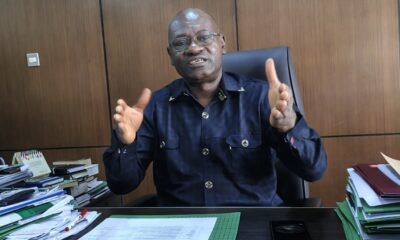
The Director General of the Institute for Peace and Conflict Resolution (IPCR), Dr. Joseph Ochogwu has disclosed that Nigeria’s path to lasting peace lies in decentralizing power, formalizing the informal sector, and rebuilding local governance, even as citizens endure the economic strain of ongoing reforms.
Speaking in an Exclusive interview with ‘The Workplace Magazine’ on Monday in Abuja, Ochogwu said IPCR, the Federal Government’s primary peace and conflict advisory body under the Ministry of Foreign Affairs, operates with “independence in thought” and provides solution-driven, evidence-based research to guide policy.
“We are independent in thought. Government does not in any way influence our research,” he said. “We do research and provide policy advisory for the Nigerian government.”
Ochogwu identified “over centralization and over concentration of power and authority” as a major driver of crisis in Nigeria. He praised the Tinubu administration’s push to “diffuse power from the center to the states and to local government.”
“Conflict is local. So also peace is local,” he said. “Every conflict you see happens among people within the local community. If you must build peace, the peace-building element also must be local.”
He lamented that local governments — the “frontline agency for conflict prevention and conflict management” — had suffered “complete deficits” from 1999 until President Tinubu assumed office. With over 8,000 wards nationwide meant to produce councilors for agriculture, health, and education, he said the grassroots structure was “cut off,” leaving problems to escalate to states and ultimately the Federal Government.
He commended the President for pursuing local government autonomy at the Supreme Court and cited decentralization of electricity generation and distribution as another key reform. He added that IPCR is advocating for decentralized policing, noting that state governments remain “titular chief security officers” without power to appoint police commissioners.
Aligning IPCR’s work with the administration’s ‘Renewed Hope’ agenda, Ochogwu said the focus has been on “reducing, reengineering, reforming and repositioning our economy” because “if the economy is the base upon which all other structures stand, and you don’t get it right, everything falls down.”
He defended the removal of fuel subsidy as a necessary sacrifice. “It’s something everybody consumed daily — factories, individuals. So it’s a sacrifice everybody is doing. The point now is: to what extent do Nigerians understand they need to make this sacrifice to build the nation we all desire?”
He warned against political sabotage. “Those not currently in power will do anything to pull the government down. As we endure these pains, we get the gains subsequently. If we pull this administration down, we’re going to suffer twice.”
On Nigeria’s varied threats — Boko Haram/ISWAP in the North-East, banditry in the North-West, farmer-herder clashes in the Middle Belt, and separatist agitation in the South-East — Ochogwu said there is “no single military doctrine for everybody.”
“A lot of the internal security threats you see are actually police functions. The military’s supposed to be focused on defense,” he said. Operations like Hadin Kai and Delta Safe, he noted, are “ad hoc military interventions” under the constitutional provision for military aid to civil authority.
He described kidnapping for ransom as driven by money, with roots in Sahelian instability. “You kidnap an average villager, people can rally around and pay $5,000 or $10,000. That’s good money for these groups.” Foreign forces, he added, have aligned with local challenges, requiring both kinetic and non-kinetic responses.
Ochogwu rejected claims that government is inactive. “There is a false assumption that people in government don’t work. I have been to the front line several times. There are men and women having sleepless nights, moving with their lives on the line.”
On deradicalisation, he said a “very rigorous profiling system” by the military, Ministry of Justice, Humanitarian Affairs, and Correctional Service determines levels of involvement. “A child forced into Boko Haram, acting as a courier, should he be prosecuted like commanders who go out to kill?” he asked. He disclosed that “about 96,000 people surrendered voluntarily from the camp of Boko Haram to the government” at one point.
IPCR is pushing for clarity on citizenship rights versus indigenous rights, which he called “a very contentious thing that leads to violence.” He questioned why someone who settles in a community for 10 years and pays tax cannot contest or vote there.
He also spotlighted Nigeria’s informal recycling economy — “scavengers,” or “baban bola” — as a security risk. “They render livelihood and economic services, but also pose a critical danger to national infrastructure assets,” he said, citing theft of copper wires and railway tracks. IPCR findings show most lack NIN or national identity. “We need to formalize them, get their bio-data, put them in clusters.”
Technology, he said, is critical to future security gains. He pointed to recent military operations where “five to seven terrorists” were taken down using technology, and cited integration with NIMC’s identity management system. “We’re coming from an analogue group. Now we’re building capacity for contemporary management of crisis.”
IPCR works with the military, intelligence, police, MDAs, states, local authorities, traditional and religious leaders, and youth groups. Internationally, it partners with UN agencies, INGOs, and bilateral partners including the UK Foreign Office.
Ochogwu said IPCR’s policy advisories range from open-source briefs to classified reports sent directly to agencies. The Institute also runs a national conflict early warning system and convenes strategic meetings, including a recent multi-dimensional security program.
“The work we do is low-key,” he said. “If you don’t know it, you don’t know it. It’s not for play.”
Ochogwu, who has spent 22 of IPCR’s 25 years at the Institute, including six years in the Villa and a stint as Conflict Adviser to the UK’s DFID, described IPCR as “one of the most creative and innovative establishments of the Nigerian government.”
“For me, the path forward is clear,” he said. “Decentralize power, formalize the informal, define citizenship, blend kinetic and non-kinetic approaches, and above all, renew hope. If we trust the reforms to take their course, we all benefit eventually. But if we pull the system down midway, we suffer twice.”