


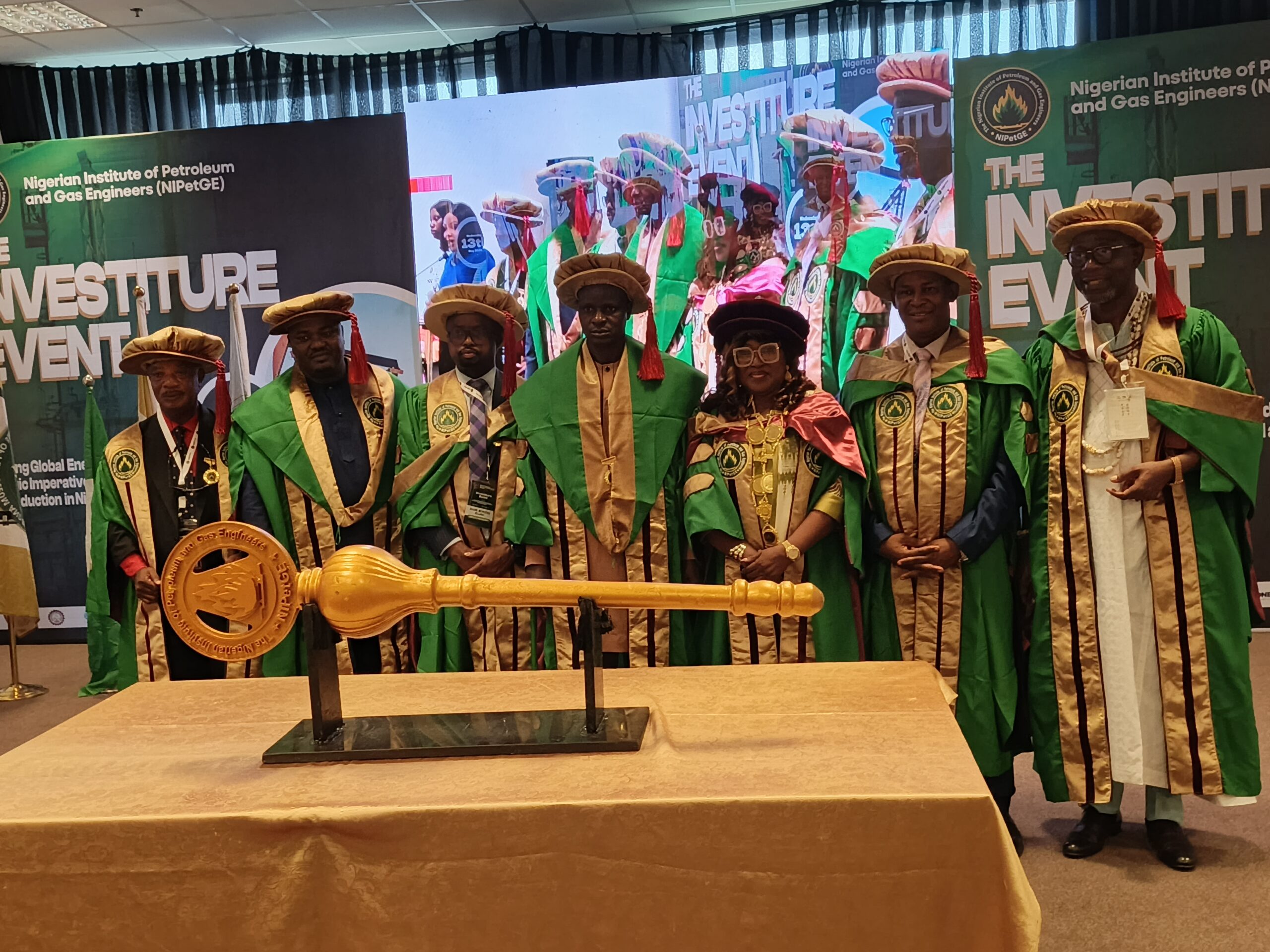
The Nigerian Institute of Petroleum and Gas Engineers (NIPetGE) has inaugurated its first president and executive council, with a pledge to take a more visible role in shaping Nigeria’s energy policy and strengthening indigenous capacity in the sector.
Engr. Prisca Kanebi was sworn in as pioneer president during the institute’s investiture ceremony in Abuja on Wednesday. Accepting the role, she said she did so “with humility, a deep sense of responsibility and a firm commitment to selfless service.”
Kanebi said nation-building was a collective responsibility and that NIPetGE, as a critical stakeholder in the energy sector, would contribute meaningfully to the formulation and implementation of strategic national policies, particularly in energy and petroleum.
“Today our nation is burdened by huge debts and an unsustainable revenue to debt service ratio, with serious implications for economic growth and national development,” she noted.
The new president said the institute had submitted memoranda to government on industry issues over time, but the impact on public policy had not always been evident. Under her leadership, the council will pursue “more proactive advocacy and thought leadership initiatives” to draw attention to policies, bills and regulations that could hinder value creation, industry growth and citizens’ welfare.
She added that NIPetGE would strengthen local and international affiliations, participate in professional networks, and work with African countries where middle-level technical support was needed. Partnerships with tertiary institutions, government agencies and regulatory bodies will focus on capacity building, research and sustainable industrial development.
‘Energy is now economic and geopolitical’
Delivering the keynote address on the theme _Emerging Global Energy Dynamics and Strategic Imperatives for Increased Oil and Gas Production in Nigeria_, LCCI Vice President Sir Ladi Smith said the relationship between finance and energy had become inseparable.
“Oli and gas are no longer just technical or engineering matters. They now determine the strength of national economies, exchange rates, government revenues, inflation levels, energy security, and even geopolitical influence,” Smith said.
He pointed to ongoing tensions in the Middle East and the strategic importance of the Strait of Hormuz, through which a significant portion of global crude and LNG passes, as evidence of how fragile global energy supply remains. Disruptions there, he said, immediately affect aviation costs, shipping, insurance premiums and crude prices worldwide.
For Nigeria, Smith said rising global crude prices should be an advantage but the country’s challenge was production.
“Nigeria’s greatest challenge today is not lack of crude oil reserves. Nigeria’s challenge is production,” he said. Insecurity in the Niger Delta, oil theft, pipeline vandalism, ageing infrastructure and regulatory uncertainty have kept output below OPEC quota, causing Nigeria to miss billions in potential revenue.
Smith stressed that gas must become central to Nigeria’s strategy. “Many experts now describe Nigeria as a gas nation with some oil,” he said, noting opportunities in power generation, industrialisation, fertiliser, petrochemicals and exports.
He also called for stronger domestic refining capacity to reduce import dependence, foreign exchange pressure and imported inflation, but said it must be matched with stable crude supply, efficient logistics and transparent pricing.
PTDF backs indigenous capacity and collaboration
In a goodwill message, PTDF Executive Secretary Prof. Shuaibu Shehu Aliyu said Nigeria must increase oil and gas production responsibly while deepening indigenous participation and human capital development.
“The global energy landscape is undergoing one of the most significant transformations in modern history,” Aliyu said. While renewables were growing, oil and gas remained critical to industries, transportation and economic growth worldwide.
Represented by the General Manager office of Executive Secretary, Mr. Mohammed Olowo said PTDF was committed to scholarships, research support and professional training to produce professionals capable of competing in a technology-driven industry. He added that natural gas offered Nigeria a pathway to balance growth with sustainability and urged stronger regional and continental cooperation for energy integration.
“At the Petroleum Technology Development Fund, we recognize that the demands of leadership in this evolving sector require constant engagement with industry stakeholders, policymakers, academic institutions, global partners, and emerging innovators,” Aliyu said.
A call to engineers
Both speakers emphasized the direct economic value of engineers’ work.
“Every improvement in production efficiency, maintenance culture, pipeline integrity, metering systems, gas utilisation, and operational reliability has direct economic value to the nation,” Smith said. “An engineer who reduces downtime improves national revenue. An engineer who prevents leakage protects foreign exchange.”
The event featured investiture sessions, induction of fellows and entertainment, marking the formal takeoff of NIPetGE as a professional body in Nigeria’s energy landscape.
Kanebi said the institute would remain engaged with government and industry to ensure that professional expertise translates into policies that strengthen production, attract investment and secure Nigeria’s place in the evolving global energy order.